Salt Cell Cleaning and Maintenance: Extend Your Cell's Life by Years
Salt chlorine generators are one of the best investments for Texas pool owners — but the salt cell itself is a consumable part that costs $400-$800 to replace. Proper cleaning and maintenance can extend your salt cell's lifespan from 3 years to 5-7 years, saving you hundreds of dollars. In DFW's hard water, scale buildup on salt cells is the number one cause of premature failure.
Here's how to keep your salt cell running efficiently and get the most life out of your investment.
How Salt Cells Work
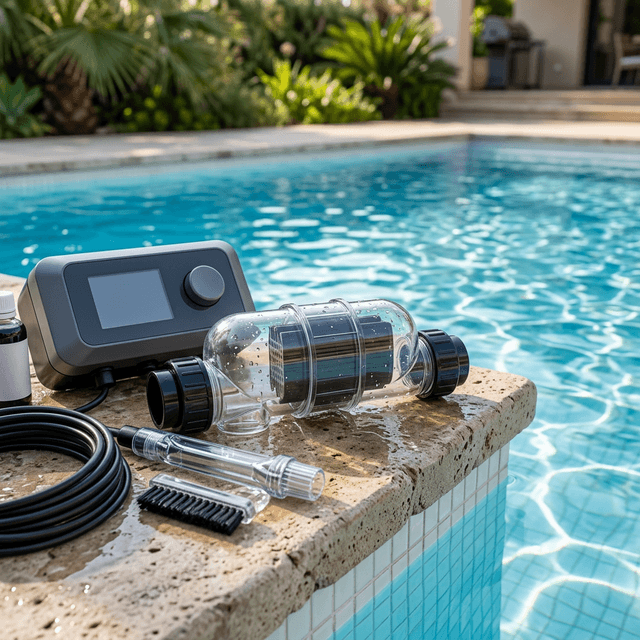
A salt cell (also called a salt chlorine generator cell, electrolytic cell, or chlorinator cell) contains metal plates coated with precious metals (typically ruthenium or iridium). When pool water flows through the cell:
- An electrical current passes through the plates
- The current breaks down dissolved salt (NaCl) into chlorine gas (Cl2) and sodium hydroxide (NaOH)
- The chlorine gas dissolves in the water, creating hypochlorous acid (the active sanitizer)
- The process is continuous as long as the pump is running and the system is enabled
The metal plates are the most expensive component. When they wear out or become coated with scale, chlorine production drops and eventually stops.
Why DFW Hard Water Is Hard on Salt Cells
North Texas water is among the hardest in the country for salt cell operation:
- High calcium hardness — DFW tap water runs 200-350 ppm calcium. Salt pools ideally want 200-400 ppm, so we're often right at the edge
- Alkaline water — High pH and alkalinity accelerate calcium carbonate deposition on cell plates
- The salt generation process itself raises pH — This compounds the scaling problem
- Well water areas (Argyle, Krum, Ponder) have even higher mineral content, creating aggressive scaling
Without regular cleaning, calcium scale coats the cell plates, insulating them from the water and reducing chlorine production. Eventually, the scale becomes so thick it damages the coating on the plates permanently.
How Often to Clean Your Salt Cell
| Water Hardness | Cleaning Frequency |
|---|---|
| Under 200 ppm calcium | Every 6 months |
| 200-300 ppm calcium | Every 3-4 months |
| 300-400 ppm calcium (common in DFW) | Every 2-3 months |
| Over 400 ppm (well water areas) | Monthly |
Additional triggers to clean:
- Salt system displays "Check Cell" or "Inspect Cell" alert
- Chlorine production drops despite adequate salt level
- You can visually see white scale on the cell plates
- System runs at high output but chlorine tests low
How to Clean a Salt Cell: Step-by-Step
What you need
- Muriatic acid (4:1 dilution — 4 parts water to 1 part acid)
- A cell cleaning stand or 5-gallon bucket tall enough to submerge the cell
- Garden hose with nozzle
- Safety goggles and acid-resistant gloves
- Plastic cap or plug for one end of the cell (some manufacturers provide a cleaning stand)
We sell salt cell cleaning kits and muriatic acid at our Northlake pool supply store.
Step-by-step cleaning process
1. Turn off the salt system and pump
2. Remove the cell from the plumbing
- Most cells have union fittings that hand-tighten
- Some have compression fittings
- Note the flow direction arrow for reinstallation
3. Inspect the cell
- Look through the cell at the plates
- White, flaky buildup = calcium scale (needs acid cleaning)
- Clean, shiny plates = cell is fine (just rinse and reinstall)
- Dark, pitted plates = cell is nearing end of life
4. Rinse with garden hose
- Flush debris out of the cell with a strong stream of water
- This removes loose particles before acid cleaning
5. Prepare the acid solution
- ALWAYS add acid to water, never water to acid
- Mix 1 part muriatic acid to 4 parts water in a bucket or cleaning stand
- This creates approximately a 6-8% acid solution — strong enough to dissolve calcium but gentle on the cell plates
6. Submerge the cell
- Place the cell in the acid solution plates-down
- You should see immediate fizzing/bubbling — this is the acid dissolving calcium
- Let it soak for 5-15 minutes
- Check progress every few minutes
- Remove as soon as the fizzing stops — don't over-soak
7. Rinse thoroughly
- Rinse the cell with clean water for 2-3 minutes
- Inspect the plates — they should be clean and visible
- If scale remains, repeat the acid soak (up to 3 times maximum)
8. Reinstall the cell
- Check O-rings and gaskets before reinstalling
- Install with the correct flow direction
- Hand-tighten unions (don't use tools — over-tightening cracks fittings)
- Turn on the pump, check for leaks
- Turn on the salt system
Important cleaning warnings
- Never use a wire brush or scraper on cell plates — this destroys the precious metal coating
- Don't exceed 15-minute soak times — prolonged acid exposure damages the plate coating
- Don't clean more often than necessary — each acid cleaning slightly reduces plate coating life
- Replace acid solution for each cleaning — used solution is less effective
- Never clean a cell that doesn't need it — if plates look clean, just rinse and reinstall
Salt Cell Settings and Optimization
Output percentage
Most salt systems have an output dial (0-100%) that controls how much chlorine the cell produces.
In DFW summer:
- Small pools (under 15,000 gal): 40-60%
- Medium pools (15,000-25,000 gal): 50-70%
- Large pools (25,000+ gal): 60-80%
In DFW winter:
- Reduce to 20-40% of summer setting
- Chlorine demand drops significantly with cooler water
Running at 100% all the time wears out the cell faster and isn't necessary. Dial back to the minimum that maintains 2-4 ppm free chlorine.
Super chlorinate / boost mode
Most systems have a "boost" or "super chlorinate" feature that runs at 100% for 24 hours. Use this:
- After heavy pool parties
- After rainstorms
- If chlorine drops below 1 ppm
- But NOT as a regular setting — it wears the cell
Salt level management
| Parameter | Ideal Range |
|---|---|
| Salt level | 2,700-3,400 ppm (varies by manufacturer) |
| Too low | Below 2,500 ppm — cell won't produce enough chlorine |
| Too high | Above 4,000 ppm — can damage equipment and cause salty taste |
- Test salt levels monthly
- Salt doesn't evaporate — you only lose salt from splash-out, backwashing, or water replacement
- When adding salt, use pool-grade salt (not rock salt or table salt)
- Add salt with the pump running and brush any undissolved salt off the floor
We carry pool-grade salt at our Northlake store — stop by or shop online.
When to Replace Your Salt Cell
Typical salt cell lifespan: 3-7 years (depending on maintenance and water chemistry)
Signs your cell needs replacement:
- System shows "Replace Cell" or low chlorine production warning consistently
- Cell won't produce adequate chlorine even after cleaning and at high output
- Plates are visibly pitted, corroded, or missing coating
- Chlorine tests consistently low despite proper salt levels and clean cell
- Cell has been cleaned many times and efficiency has declined
- System throws error codes related to cell voltage or current
Replacement costs:
- Pentair IntelliChlor IC40: $500-$700
- Hayward T-Cell-15: $400-$600
- Jandy AquaPure: $450-$650
- Generic/aftermarket cells: $250-$450
We supply and install salt cells for all major brands. Contact us for pricing on your specific system.
Products That Help
Salt cell cleaning solution — pre-mixed acid solution designed specifically for salt cell cleaning. Safer and easier than mixing your own muriatic acid solution. Available at our Northlake store.
Muriatic acid — for DIY cleaning solution mixing. Available in gallon containers at our store.
Pool-grade salt — pure salt without anti-caking agents or iodine that can damage cells. We stock 40-lb bags at our store.
Scale inhibitor / sequestrant — monthly use prevents scale from forming on cell plates in the first place, extending cell life significantly. Critical for DFW's hard water. Available at our store and online shop.
Salt test strips — quick and accurate salt level testing. Available at our store.
Professional Salt System Service
Our weekly maintenance plans include salt system monitoring:
- Salt level testing every visit
- Cell inspection during regular maintenance
- Cell cleaning as needed (included in Basic and Premium plans)
- System optimization — output adjustments for seasonal changes
- Cell replacement when needed
If you're having salt cell issues, schedule a service call or call (469) 455-1054. We service Pentair, Hayward, Jandy, and all major salt system brands.
Salt systems save time and money when properly maintained. Simplified Pools keeps your salt cell clean and efficient. Serving Northlake, Argyle, Flower Mound, Trophy Club, and all DFW North. Get your free quote.