Pool Pump Sizing Guide: How to Choose the Right Pump for Your Pool
Choosing the wrong size pool pump is one of the most expensive mistakes a pool owner can make. An oversized pump wastes energy, creates excessive noise, damages filters, and can cause plumbing failures. An undersized pump can't circulate water fast enough, leading to poor filtration, algae growth, and inadequate chemical distribution. The right pump moves enough water to turn over your entire pool volume once per day at the minimum flow rate needed for your plumbing and equipment.
Here's how to size a pool pump correctly, with specific guidance for DFW residential pools.
Why Pump Sizing Matters
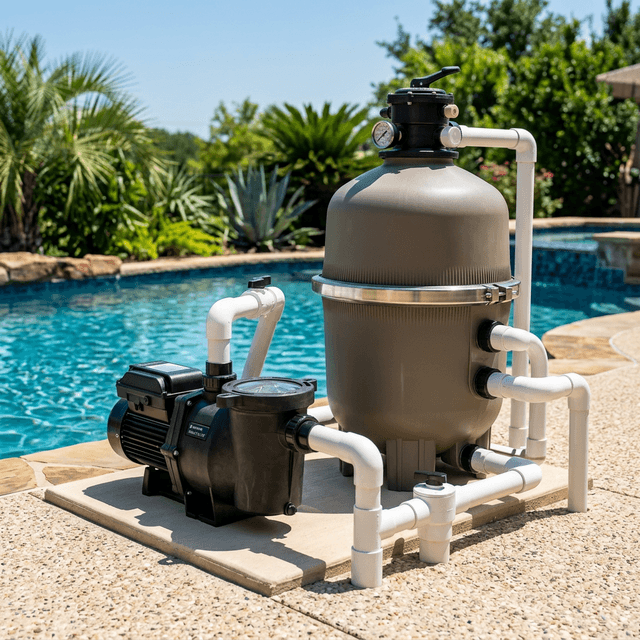
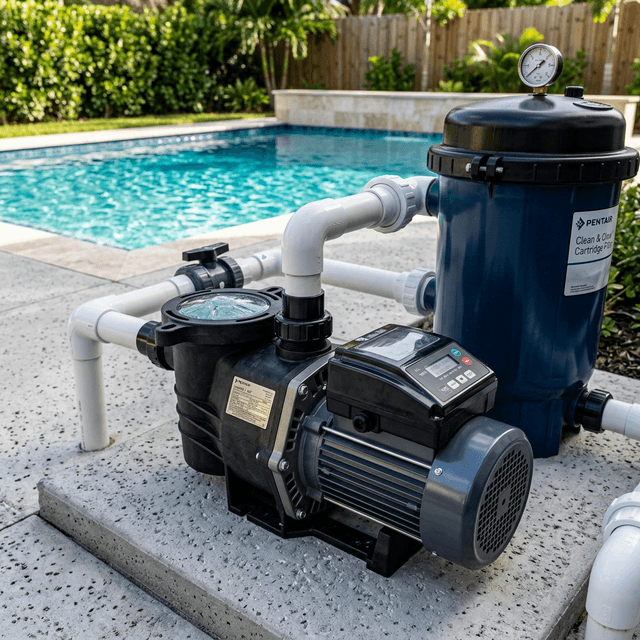
Your pool pump is the heart of the entire system. It pulls water from the pool, pushes it through the filter, heater, salt cell, and other equipment, and returns it to the pool. Every piece of equipment downstream depends on the pump delivering the right amount of water at the right pressure.
What happens with an oversized pump
- Wastes electricity — a pump that's too powerful draws significantly more energy than needed
- Damages the filter — excessive flow rate blows through filter media, channeling sand, tearing cartridge elements, or bypassing DE grids
- Creates plumbing stress — high-velocity water causes pipe vibration, increases the risk of leaks at joints, and accelerates wear on valves and fittings
- Noisy operation — water moving too fast through undersized plumbing creates turbulence and noise
- Air entrainment — oversized pumps can create cavitation and air pockets, reducing filtration effectiveness
- Shorter equipment lifespan — everything in the system wears faster under excessive pressure
What happens with an undersized pump
- Inadequate filtration — water doesn't pass through the filter often enough, leading to persistent cloudiness
- Algae growth — stagnant areas and poor circulation create dead spots where algae thrives
- Poor chemical distribution — chemicals don't mix evenly throughout the pool
- Insufficient flow for equipment — heaters, salt cells, and chlorinators all have minimum flow requirements; below those thresholds, they won't operate or will throw error codes
- Longer run times needed — an undersized pump needs to run longer to achieve one turnover, increasing energy consumption
Step 1: Calculate Your Pool Volume
You need to know how many gallons your pool holds. If you don't already know, use these formulas.
Rectangular or square pools
Length x Width x Average Depth x 7.5 = gallons
Average depth = (shallow end depth + deep end depth) / 2
Example: 30 ft x 15 ft x 5 ft average depth x 7.5 = 16,875 gallons
Circular pools
Diameter x Diameter x Average Depth x 5.9 = gallons
Example: 18 ft diameter x 18 ft x 4.5 ft average depth x 5.9 = 8,602 gallons
Oval pools
Long Diameter x Short Diameter x Average Depth x 5.9 = gallons
Example: 24 ft x 12 ft x 5 ft x 5.9 = 8,496 gallons
Kidney / freeform pools
Length x Width x Average Depth x 7.0 = gallons (approximate — freeform pools vary)
Example: 35 ft x 16 ft x 5.5 ft average depth x 7.0 = 21,560 gallons
Most common DFW pool sizes
The majority of residential pools in Northlake, Argyle, Flower Mound, Trophy Club, and surrounding areas fall in the 10,000-25,000 gallon range. Here's a quick reference:
| Pool Description | Typical Size |
|---|---|
| Small plunge/cocktail pool | 5,000-8,000 gallons |
| Standard residential pool | 10,000-15,000 gallons |
| Medium residential pool | 15,000-20,000 gallons |
| Large residential pool | 20,000-30,000 gallons |
| Very large / custom pool | 30,000-50,000+ gallons |
Step 2: Determine Required Flow Rate (GPM)
Flow rate is measured in gallons per minute (GPM). Your target is to turn over your entire pool volume at least once in 8 hours (industry standard) or ideally once in 6-8 hours for Texas pools where heat and UV increase demand.
Turnover rate formula
Pool Volume / Turnover Time (in minutes) = Required GPM
Example for a 20,000-gallon pool with 8-hour turnover:
20,000 gallons / 480 minutes = 41.7 GPM
GPM requirements by pool size
| Pool Size (gallons) | 8-Hour Turnover GPM | 6-Hour Turnover GPM |
|---|---|---|
| 10,000 | 20.8 GPM | 27.8 GPM |
| 12,000 | 25.0 GPM | 33.3 GPM |
| 15,000 | 31.3 GPM | 41.7 GPM |
| 18,000 | 37.5 GPM | 50.0 GPM |
| 20,000 | 41.7 GPM | 55.6 GPM |
| 25,000 | 52.1 GPM | 69.4 GPM |
| 30,000 | 62.5 GPM | 83.3 GPM |
DFW recommendation: For pools with attached spas, water features, or in-floor cleaning systems, use the 6-hour turnover rate. These systems increase the demand on the pump.
Minimum flow requirements for equipment
Your pump also needs to meet minimum flow requirements for downstream equipment:
| Equipment | Typical Minimum Flow |
|---|---|
| Pool heater (gas) | 25-40 GPM |
| Heat pump | 25-45 GPM |
| Salt chlorine generator | 20-35 GPM |
| In-floor cleaning system | 40-60 GPM |
| Suction-side cleaner | 20-30 GPM (dedicated line) |
| UV/ozone system | 15-30 GPM |
Your pump must deliver at least the highest minimum flow requirement among all your equipment, plus enough to achieve turnover.
Step 3: Calculate Total Dynamic Head (TDH)
This is where pump sizing gets technical — and where most mistakes happen. Total dynamic head (TDH) is the total resistance your pump must overcome to move water through the entire system. It's measured in feet of head.
Why it matters: A pump's flow rate drops as head pressure increases. A pump rated for 80 GPM at 20 feet of head might only deliver 40 GPM at 50 feet of head. If you don't account for TDH, you'll pick a pump that can't deliver the flow you need.
Components of TDH
1. Vertical lift (static head) The vertical distance from the water surface to the highest point water must travel. For most residential pools with equipment at deck level, this is 1-3 feet.
2. Friction loss in pipes Every foot of pipe creates friction that the pump must overcome. This depends on:
- Pipe diameter: 1.5-inch pipe has much more friction than 2-inch pipe
- Pipe length: Longer runs = more friction
- Pipe material: PVC is smoother than older copper or galvanized
- Flow rate: Higher GPM = more friction
Friction loss per 100 feet of pipe (at 60 GPM):
| Pipe Size | Friction Loss per 100 ft |
|---|---|
| 1.5-inch PVC | 10.5 ft of head |
| 2.0-inch PVC | 3.0 ft of head |
| 2.5-inch PVC | 1.1 ft of head |
| 3.0-inch PVC | 0.4 ft of head |
This is why 2-inch plumbing makes such a difference. If your pool has 1.5-inch plumbing (common in older DFW pools), you face significantly more resistance, and your pump selection changes accordingly.
3. Friction loss in fittings Every elbow, tee, valve, and fitting adds resistance. A typical residential pool system has 10-20 fittings.
Approximate equivalent feet of straight pipe per fitting (1.5-inch):
| Fitting | Equivalent Feet |
|---|---|
| 90-degree elbow | 5 ft |
| 45-degree elbow | 2.5 ft |
| Tee (branch flow) | 6 ft |
| Gate valve (open) | 1 ft |
| Check valve | 10 ft |
| Ball valve (open) | 5 ft |
4. Equipment resistance Each piece of equipment in the plumbing loop adds head pressure:
| Equipment | Approximate Head Loss |
|---|---|
| Cartridge filter (clean) | 3-5 ft |
| Cartridge filter (dirty) | 10-15 ft |
| Sand filter (clean) | 3-5 ft |
| Sand filter (dirty) | 8-12 ft |
| DE filter (clean) | 3-5 ft |
| DE filter (dirty) | 10-15 ft |
| Gas heater | 5-10 ft |
| Heat pump | 3-5 ft |
| Salt cell | 1-3 ft |
| Solar panels (roof-mounted) | 10-20 ft |
Calculating your TDH
TDH = Static Head + Pipe Friction Loss + Fitting Friction Loss + Equipment Resistance
Example calculation for a typical DFW residential pool:
- Static head: 2 ft
- 100 ft of 2-inch PVC pipe: 3 ft
- 15 fittings (equivalent to 50 ft of pipe): 1.5 ft
- Cartridge filter (average): 8 ft
- Salt cell: 2 ft
- Gas heater: 7 ft
- Total TDH: 23.5 ft
Most residential pools in the DFW area have a TDH between 20-50 feet. Pools with roof-mounted solar heating, long plumbing runs, or older 1.5-inch plumbing tend to be at the higher end.
Quick estimate method: If you don't want to calculate every fitting and pipe length:
- Simple system (short runs, 2-inch pipe, no heater): 20-30 ft TDH
- Standard system (moderate runs, filter + heater): 30-40 ft TDH
- Complex system (long runs, solar, water features, 1.5-inch pipe): 40-55 ft TDH
Step 4: Select the Right Pump
Now you know three things: your required GPM, your TDH, and (ideally) your pump type preference. Use the pump's performance curve to find a model that delivers your required GPM at your calculated TDH.
Reading a pump performance curve
Every pump manufacturer publishes performance curves showing the relationship between flow rate and head pressure. The curve slopes downward — as head pressure increases, flow rate decreases.
How to use the curve:
- Find your TDH on the vertical axis (feet of head)
- Draw a horizontal line across to where it intersects the pump curve
- Drop down to the horizontal axis to read the GPM at that head pressure
- That GPM must meet or exceed your required turnover GPM
If the GPM at your TDH is too low, move up to a larger pump. If it's far more than needed, move down to a smaller pump or (better yet) choose a variable speed pump.
Single-speed vs. dual-speed vs. variable-speed
Single-speed pumps
- Run at one fixed speed (typically 3,450 RPM)
- Least expensive upfront ($200-$500)
- Most expensive to operate ($60-$100+/month in electricity)
- Being phased out by Department of Energy regulations
- No longer recommended for new installations
Dual-speed pumps
- Two speeds: high (3,450 RPM) and low (1,725 RPM)
- Moderate cost ($400-$700)
- Low speed saves significant energy for daily filtration
- High speed available when needed for vacuuming, spa jets, water features
- A reasonable budget option
Variable-speed pumps
- Adjustable speed from ~600 RPM to 3,450 RPM
- Most expensive upfront ($800-$2,000+)
- Least expensive to operate ($10-$25/month)
- Programmable for different speeds at different times
- Quietest operation
- Required by DOE regulations for new installations (since 2021) for pumps above 1.0 HP
- Pays for itself in 1-3 years through energy savings
For a deep dive on variable speed economics, see our guide: Are Variable Speed Pumps Worth It?
Our recommendation for DFW pools: Variable speed pumps are the clear winner for any pool in our area. Texas pools run year-round, electricity costs add up, and the energy savings are substantial. The pump pays for itself quickly and runs quieter — important when your equipment pad is near outdoor living spaces, which is common in DFW new construction.
Step 5: Verify Plumbing Compatibility
Maximum flow rates for pipe sizes
Every pipe size has a maximum recommended flow velocity. Exceeding it causes noise, vibration, pipe wear, and air entrainment.
| Pipe Size | Maximum Recommended GPM |
|---|---|
| 1.5-inch | 43 GPM |
| 2.0-inch | 73 GPM |
| 2.5-inch | 113 GPM |
| 3.0-inch | 160 GPM |
Critical note for older DFW pools: Many pools built in the 1990s and early 2000s in the North Texas area used 1.5-inch plumbing exclusively. This limits you to 43 GPM maximum regardless of pump size. Installing a 2 HP pump on 1.5-inch plumbing is like putting a fire hydrant on a garden hose — the pump cavitates, the plumbing suffers, and you don't get the flow you're paying for.
If your pool has 1.5-inch plumbing and you need more than 40 GPM, either:
- Accept the limitation and use a variable speed pump at moderate speeds
- Replumb to 2-inch pipe (significant project but worth it for larger pools)
Suction-side vs. pressure-side considerations
The suction side (from pool to pump) is more sensitive to sizing than the pressure side. Keep suction-side velocity below 6 feet per second to prevent cavitation and air leaks. This is another reason why oversizing a pump on small plumbing causes problems.
Common Pump Sizing Mistakes
Mistake 1: Choosing by horsepower alone
"I have a 15,000-gallon pool, so I need a 1.5 HP pump." This logic ignores plumbing size, TDH, and actual GPM delivery. A 1.5 HP pump might deliver 80 GPM at 20 feet of head but only 45 GPM at 50 feet. Horsepower alone tells you almost nothing about whether the pump fits your pool.
Mistake 2: Bigger is better
This is the most common mistake. Pool owners (and some contractors) install the biggest pump they can find, thinking more flow is always better. The result: wasted energy, excessive noise, filter damage, and plumbing stress. With variable speed pumps, the entire "bigger is better" mentality is obsolete — you dial in exactly the flow you need.
Mistake 3: Not accounting for dirty filter head loss
Your filter's resistance doubles or triples as it gets dirty between cleanings. If you size your pump for a clean filter's head loss, you won't have enough flow when the filter is dirty. Always calculate TDH using dirty filter head loss numbers.
Mistake 4: Ignoring plumbing diameter
Installing a powerful pump on 1.5-inch plumbing is extremely common in DFW pool renovations. The homeowner upgrades the pump but not the plumbing, and the new pump can't deliver its rated performance. Always check pipe diameter before selecting a pump.
Mistake 5: Replacing "like for like" without evaluation
When an old pump dies, many homeowners buy the exact same model. But your pool's needs may have changed — new equipment was added, plumbing has aged, or the original pump was the wrong size to begin with. Every pump replacement is an opportunity to right-size.
Mistake 6: Not considering altitude and temperature
DFW is approximately 600-800 feet above sea level, which slightly reduces pump performance compared to sea level ratings. More significantly, water temperature affects pump performance — hot Texas water (85-95 degrees F) is more prone to cavitation on the suction side. Size conservatively.
Sizing Examples for Common DFW Pools
Example 1: Small pool, basic system
- Pool: 12,000 gallons, rectangular
- Equipment: Cartridge filter, no heater, no salt cell
- Plumbing: 2-inch PVC, 60 ft total run, standard fittings
- TDH estimate: 22-28 ft
- Required GPM: 25 GPM (8-hour turnover)
- Recommended pump: 1.0 HP variable speed (e.g., Pentair SuperFlo VS, Hayward MaxFlo VS)
- Run at: 1,800-2,200 RPM for daily filtration, 3,000+ RPM for vacuuming
Example 2: Medium pool with heater and salt cell
- Pool: 18,000 gallons, freeform
- Equipment: Cartridge filter, gas heater, salt chlorine generator
- Plumbing: 2-inch PVC, 80 ft total run, moderate fittings
- TDH estimate: 32-40 ft
- Required GPM: 37.5 GPM (8-hour turnover), heater needs 30 GPM minimum
- Recommended pump: 1.5 HP variable speed (e.g., Pentair IntelliFlo VSF, Hayward TriStar VS)
- Run at: 2,000-2,400 RPM for daily filtration, 2,800+ RPM for heater operation
Example 3: Large pool with spa and water features
- Pool + spa: 28,000 gallons total
- Equipment: Cartridge filter, heater, salt cell, spa jets, spillover water feature
- Plumbing: 2-inch PVC (2.5-inch on main return), 120 ft total run, many fittings
- TDH estimate: 38-48 ft
- Required GPM: 58 GPM (8-hour turnover), spa jets need 60+ GPM
- Recommended pump: 2.0-2.7 HP variable speed (e.g., Pentair IntelliFlo3 VSF, Hayward VS Omni)
- Run at: 1,800-2,200 RPM for daily filtration, 3,200+ RPM for spa jets, medium speed for water features
When to Upgrade Your Pump
Consider a pump upgrade when:
- Your pump is over 8-10 years old — efficiency decreases with age, and modern variable speed pumps pay for themselves quickly
- Your energy bills are high — a single-speed pump running 10-12 hours daily costs $60-$100/month in DFW. A variable speed replacement can cut that to $10-$25
- You've added equipment — a new heater, salt cell, or water feature may require more flow than your current pump delivers
- Your pump is noisy — worn bearings, cavitation, and vibration indicate a pump nearing end of life
- You have water quality issues — poor circulation from an undersized or failing pump causes algae, cloudiness, and chemical distribution problems
- You still have a single-speed pump — the energy savings alone justify the upgrade in almost every case
For detailed energy savings calculations, read our guide on pool energy saving tips.
Professional Pump Sizing and Installation
Getting pump sizing exactly right requires measuring your plumbing, calculating actual TDH, evaluating your equipment requirements, and matching everything to a specific pump model and speed program. It's one of the most technical decisions in pool ownership.
What we do differently:
- Measure actual pipe diameters and plumbing runs
- Calculate your pool's true TDH (not estimate or guess)
- Check minimum flow requirements for all your equipment
- Recommend the right pump model AND program the optimal speed settings
- Install to manufacturer specifications with proper bonding and electrical
- Test flow rate after installation to verify performance
We install and service pumps from Pentair, Hayward, Jandy, and other major brands. Visit our Northlake store to see pump options in person, or browse our online shop.
Need a pump replacement or upgrade? Get your free quote or call (469) 455-1054. We serve Northlake, Argyle, Flower Mound, Trophy Club, Justin, Roanoke, Bartonville, Westlake, Denton, Highland Village, Lewisville, Southlake, Corinth, Lantana, and all DFW North communities.
Simplified Pools provides expert pool pump sizing, installation, and repair throughout DFW North. We serve Northlake, Argyle, Flower Mound, Trophy Club, Justin, Roanoke, Krum, Ponder, Bartonville, Westlake, Denton, Highland Village, Lewisville, Southlake, Corinth, Lantana, Cross Roads, Haslet, and surrounding areas. Contact us for professional pump service.