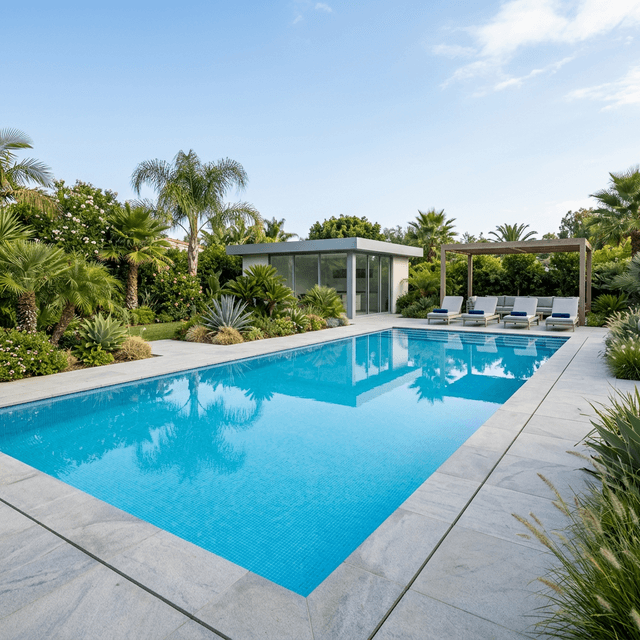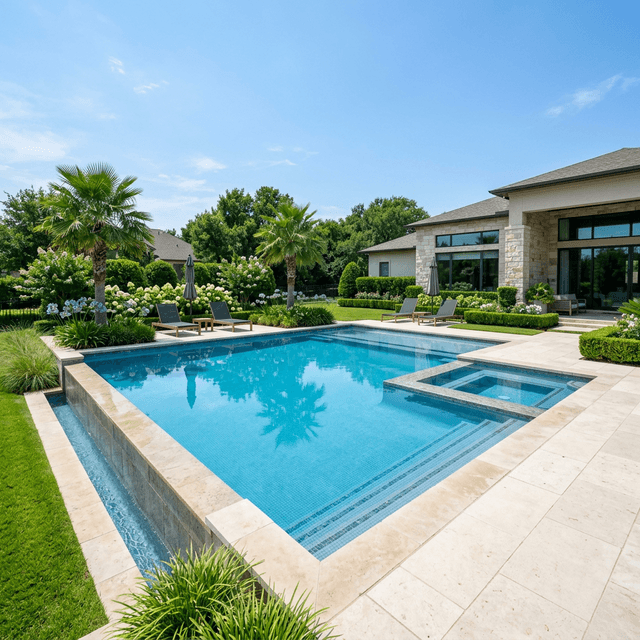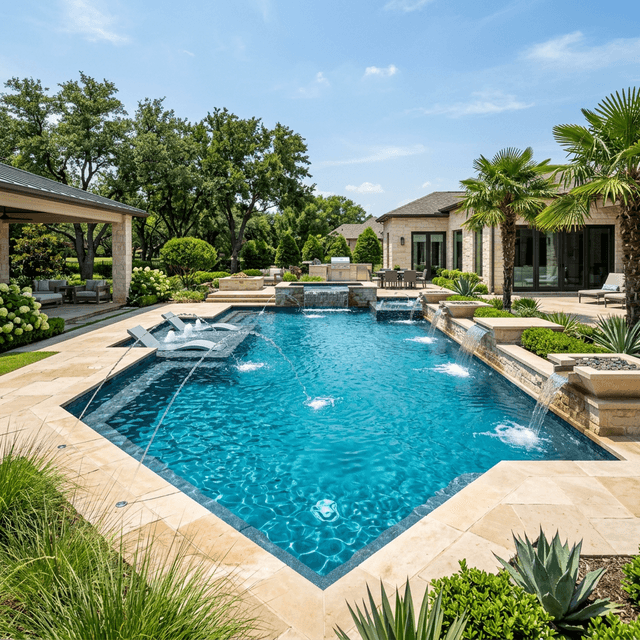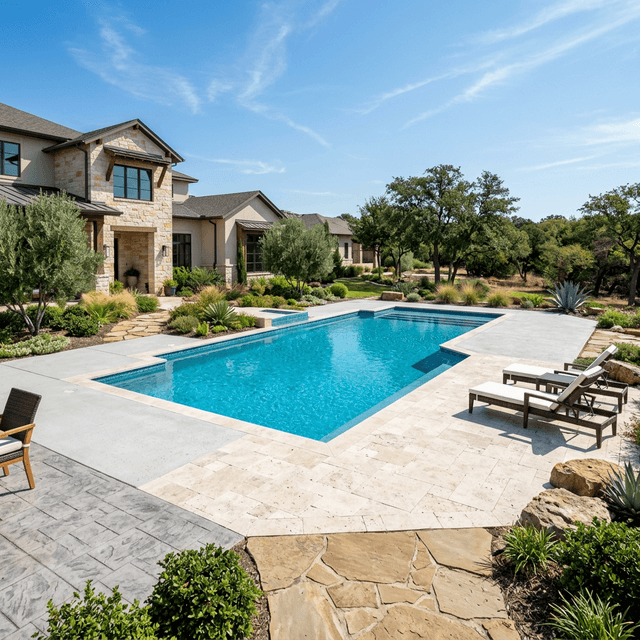
Pool Deck Options for DFW: Concrete, Pavers, Travertine & More Compared
Your pool deck is the largest visible surface in your backyard. It affects comfort, safety, aesthetics, and home value — and in the DFW heat, the wrong material choice can make your pool area unusable during the hottest months. Surface temperature, slip resistance, durability against Texas weather, and long-term maintenance costs matter as much as how it looks on day one.
Here's a detailed comparison of every major pool deck option available to DFW homeowners, with honest cost breakdowns, heat performance data, and recommendations for our specific climate.
What Makes DFW Different
Before comparing materials, understand the conditions your pool deck faces in North Texas:
- Extreme heat exposure: Surface temperatures on dark materials regularly exceed 150 degrees Fahrenheit during June through September. Bare feet can burn in seconds on the wrong surface.
- Freeze-thaw cycles: DFW gets 5-15 freeze events per winter, sometimes dropping into the teens. Water trapped in porous materials expands and causes spalling, cracking, and surface delamination.
- Expansive clay soil: Much of Northlake, Argyle, Flower Mound, Trophy Club, and the surrounding area sits on expansive montmorillonite clay. This soil swells significantly when wet and shrinks when dry, creating ground movement that cracks rigid surfaces and shifts pavers.
- UV intensity: Year-round strong UV exposure fades colors and breaks down sealers faster than northern climates.
- Alkaline water: DFW tap water is hard and alkaline, leaving mineral deposits on surfaces. Pool splash water carries chemicals that can stain or etch certain materials.
Any deck material you choose must handle all five of these conditions simultaneously.
Pool Deck Material Options
Brushed Concrete (Broom Finish)
The standard pool deck material in DFW. A poured concrete slab with a textured broom finish for traction.
Cost: $8-$15 per square foot installed
Pros:
- Lowest initial cost
- Proven durability — thousands of DFW pools have had brushed concrete decks for 20+ years
- Good slip resistance when the broom texture is properly applied
- Can be stained or coated later to update the look
- Simple to repair cracks and patch sections
Cons:
- Gets extremely hot in summer — light gray concrete reaches 130-140 degrees Fahrenheit in direct sun
- Plain appearance — functional but not visually exciting
- Cracks are inevitable in DFW clay soil, typically within 3-7 years. Control joints help but don't eliminate cracking.
- Stains from leaves, rust, and pool chemicals over time
Best for: Budget-conscious projects, pools where deck area is small, or situations where you plan to add a coating or overlay later.
DFW-specific note: Properly placed control joints (every 8-10 feet and at stress points) are critical in North Texas. Many builders space them too far apart, leading to random cracking. Insist on close joint spacing and reinforcement.
Stamped Concrete
Poured concrete with a pattern stamped into the surface before it cures, then colored and sealed to mimic stone, brick, tile, or other materials.
Cost: $12-$25 per square foot installed
Pros:
- Wide variety of patterns and colors — can convincingly mimic flagstone, slate, brick, or tile
- Continuous surface without joints (except control joints)
- Higher-end appearance than brushed concrete at a moderate cost
- Durable when properly sealed
Cons:
- Slippery when wet — this is the biggest concern. Sealed stamped concrete is notably more slippery than brushed concrete when wet. Anti-slip additives help but don't fully solve this.
- Gets very hot — sealed, dark-colored stamped concrete is the hottest common deck material
- Sealer maintenance — requires resealing every 2-3 years ($1-$3 per square foot). Unsealed stamped concrete looks washed out and stains.
- Cracking is visible and harder to repair than brushed concrete — a crack across a stamped pattern is very noticeable
- Color fading in DFW's UV environment is common within 3-5 years
Best for: Homeowners who want the look of natural stone at a lower cost and understand the maintenance commitment.
DFW-specific note: Choose lighter colors to reduce heat. Add non-slip additive (aluminum oxide or polymer grit) to the sealer. Budget for resealing every 2 years in Texas sun — the 3-5 year sealer life claimed by manufacturers assumes less UV exposure than we get here.
Concrete Pavers
Individual manufactured concrete units laid in patterns on a compacted sand or gravel base. Available in an enormous range of shapes, colors, and textures.
Cost: $15-$30 per square foot installed
Pros:
- Individual units flex with ground movement — this is the biggest advantage in DFW. Pavers shift slightly rather than cracking, and they're far more forgiving of our expansive clay soil than poured concrete.
- Damaged pavers can be individually replaced without affecting the surrounding area
- Good slip resistance — textured pavers provide excellent wet traction
- Wide variety of colors, shapes, and patterns
- No sealing required (though sealing enhances color)
- Very long lifespan — quality pavers last 25-40 years
Cons:
- Higher initial cost than poured concrete
- Sand between joints can wash out, requiring periodic re-sanding
- Weeds can grow in joints if not treated with polymeric sand
- Ants and insects sometimes colonize the sand base
- Can settle unevenly if the base material isn't properly compacted
- Edge restraints are required to prevent spreading
Best for: DFW homeowners who want durability, repairability, and good heat performance. The best all-around choice for our soil conditions.
DFW-specific note: Insist on a minimum 6-inch compacted gravel base and polymeric sand in all joints. This prevents settling and dramatically reduces weed growth and insect issues. Cheap paver installations that skip the proper base fail within 3-5 years in our clay soil.
Travertine Pavers
Natural limestone pavers (travertine is a type of limestone formed near hot springs) that have become the premium pool deck choice in DFW.
Cost: $20-$45 per square foot installed
Pros:
- Stays dramatically cooler than concrete — travertine's cellular structure and light color can be 20-30 degrees cooler than concrete in direct sun. This is the single biggest advantage for Texas pool decks.
- Naturally slip-resistant — the porous, textured surface provides excellent wet traction
- Beautiful, high-end appearance with natural variation in color and pattern
- Individual units can be replaced if damaged
- Handles freeze-thaw well when properly sealed
- Increases home value — travertine is a recognized premium upgrade
Cons:
- Higher cost than concrete options
- Requires sealing every 2-3 years to prevent staining and water absorption
- Porous surface can absorb spills, sunscreen, and leaf stains if not sealed
- Heavier than concrete pavers — installation requires more labor
- Color variation between production lots — buy all material at once
- Can etch from highly acidic pool water or spills
Best for: Premium pool renovations where comfort and aesthetics are top priorities. Homeowners who want the coolest possible deck surface.
DFW-specific note: Tumbled or unfilled travertine provides better slip resistance than honed. French pattern (multiple sizes) is the most popular layout in DFW. Use a penetrating sealer rather than a topical sealer — topical sealers peel in Texas heat and UV.
Natural Flagstone
Irregularly shaped natural stone pieces (typically sandstone, limestone, or quartzite) set in mortar on a concrete base or laid dry on a gravel base.
Cost: $20-$40 per square foot installed
Pros:
- Unique, natural appearance — every installation is one-of-a-kind
- Excellent heat performance with lighter stone colors
- Very durable — natural stone lasts decades
- Good slip resistance on most stone types
Cons:
- Irregular surfaces can be uncomfortable for bare feet (especially with raised mortar joints)
- Mortar-set flagstone cracks with ground movement (same issue as any rigid installation in clay soil)
- Dry-set flagstone can shift and become uneven over time
- More expensive than manufactured pavers with less consistent appearance
- Harder to replace individual pieces — matching natural stone is difficult
- Mortar joints require periodic maintenance
Best for: Natural, rustic pool designs. Pools surrounded by natural landscaping where a manufactured look would feel out of place.
DFW-specific note: For DFW clay soil, dry-set (sand base) flagstone with tight joints handles ground movement better than mortar-set. If using mortar, expect to do joint repairs every 5-8 years as the ground moves.
Cool Deck Coatings (Kool Deck, Sundek, etc.)
A textured acrylic coating applied over existing concrete to reduce surface temperature. Can be applied to new or existing pool decks.
Cost: $6-$12 per square foot (applied over existing concrete)
Pros:
- Dramatically reduces surface temperature — up to 30% cooler than uncoated concrete
- Can be applied over existing concrete — no demolition needed
- Wide range of colors and textures
- Adds slip resistance to smooth concrete
- Lowest cost way to improve an existing deck
Cons:
- Durability is limited — most cool deck coatings last 5-10 years before needing reapplication
- Peeling, chipping, and wear are common, especially in high-traffic areas
- Color fades in UV exposure
- Doesn't fix underlying structural issues (cracks in concrete telegraph through the coating)
- Multiple layers over the years can build up and become a maintenance problem
- Wet performance varies by product — some coatings become slippery when wet
Best for: Budget renovations where the existing concrete is structurally sound but too hot or aesthetically outdated. A good interim solution before a full deck replacement.
DFW-specific note: Cool deck coatings work well in DFW but require more frequent reapplication than manufacturers suggest. Budget for recoating every 5-7 years rather than the 10-15 years often claimed. The Texas sun and foot traffic take a toll.
Cost Comparison Table
| Material | Cost/Sq Ft | 1,000 Sq Ft Deck | Heat Rating | Slip Resistance | Maintenance Cost/Year | Expected Life |
|---|---|---|---|---|---|---|
| Brushed Concrete | $8-$15 | $8,000-$15,000 | Poor | Good | $100-$300 | 20-30 years |
| Stamped Concrete | $12-$25 | $12,000-$25,000 | Poor | Fair | $500-$1,500 | 15-25 years |
| Concrete Pavers | $15-$30 | $15,000-$30,000 | Good | Good-Excellent | $200-$500 | 25-40 years |
| Travertine | $20-$45 | $20,000-$45,000 | Excellent | Excellent | $300-$800 | 25-40 years |
| Flagstone | $20-$40 | $20,000-$40,000 | Good-Excellent | Good | $300-$700 | 25-40+ years |
| Cool Deck Coating | $6-$12 | $6,000-$12,000 | Very Good | Good | $200-$500 | 5-10 years |
Costs reflect DFW market rates as of early 2026 including materials and installation. Actual costs vary based on site conditions, access, and complexity.
Heat Performance: What Actually Matters
In DFW, surface temperature is not optional information — it's a primary decision factor. Here's what you need to know:
Peak surface temperatures in direct July sun (approximate):
- Dark stamped concrete (sealed): 150-160+ degrees Fahrenheit
- Light brushed concrete: 130-140 degrees Fahrenheit
- Concrete pavers (medium color): 120-135 degrees Fahrenheit
- Cool deck coating: 110-120 degrees Fahrenheit
- Travertine (ivory/light): 105-115 degrees Fahrenheit
- Light flagstone: 105-120 degrees Fahrenheit
Burn threshold: Skin begins to burn at approximately 125 degrees Fahrenheit with sustained contact. Children and pets are more sensitive.
The practical impact: With dark stamped concrete at 155 degrees Fahrenheit, you literally cannot walk barefoot from your patio to the pool in July without burning your feet. With travertine at 110 degrees Fahrenheit, it's warm but walkable. This is not a minor difference — it determines whether your pool area is actually usable during the four hottest months of the year.
Our recommendation: If you're building new or doing a full deck replacement, choose a material that stays below 125 degrees Fahrenheit in peak sun. In DFW, that means travertine, cool deck coatings, or light-colored concrete pavers. Your family (and your dog) will thank you every summer.
Durability and DFW Soil Conditions
Expansive clay soil is the biggest durability factor for pool decks in our area. The clay swells with moisture and shrinks during drought, creating cyclical ground movement that stresses any rigid surface.
How each material handles soil movement:
- Poured concrete (brushed or stamped): Cracks. Control joints help direct cracks to planned locations, but random cracking is still common. Stamped concrete cracks are more visible and harder to repair.
- Concrete pavers: Flex with movement. Individual units shift slightly rather than cracking. This is the most forgiving option for DFW soil. Periodic re-leveling of small areas may be needed.
- Travertine pavers: Same flexible behavior as concrete pavers. Very forgiving of soil movement when laid on a proper gravel base.
- Flagstone (dry-set): Flexes with movement. May need periodic re-leveling. Very forgiving.
- Flagstone (mortar-set): Cracks like poured concrete. Mortar joints are the failure point.
- Cool deck coating: Follows whatever the underlying concrete does. If the concrete cracks, the coating cracks.
Resurfacing an Existing Deck
If your current concrete deck is in decent structural condition but looks tired, you have options short of full replacement:
Cool deck coating: $6-$12 per square foot. Applied directly over existing concrete. Improves heat, appearance, and traction. Good for 5-10 years.
Concrete overlay (micro-topping): $8-$15 per square foot. A thin polymer-modified cement layer applied over existing concrete. Can be stamped, textured, or stained. Lasts 10-15 years.
Paver overlay: $12-$25 per square foot. Thin pavers (3/4 inch to 1 inch thick) designed to lay directly over existing concrete using a bonding compound. Provides all the benefits of pavers without demolition.
Full removal and replacement: $15-$45+ per square foot depending on material. Includes demolition and disposal of existing concrete ($3-$5 per square foot for demo alone), then new base and material installation.
When resurfacing makes sense: The existing concrete is level, structurally sound, and not heavily cracked (hairline cracks are acceptable). The concrete is at the correct elevation relative to the pool coping and house.
When replacement is necessary: Significant cracking or settling, concrete has heaved above the coping level, severe drainage problems, or the concrete is deteriorating structurally.
Coordinating Deck Work with Other Pool Renovations
Pool deck work is disruptive and expensive on its own. If you're also considering pool replastering or coping replacement, doing everything at once saves significant money:
- Coping and deck are connected — removing old coping usually damages the adjacent deck. If you're replacing coping, plan deck repair or replacement at the same time.
- Plaster and coping are connected — replastering often includes coping work. Bundle all three for maximum savings.
- One mobilization — contractor setup, equipment rental, and site prep happen once instead of multiple times.
- Typical savings: 15-25% on the total project when bundling compared to doing each project separately.
Choosing the Right Contractor in DFW
Pool deck installation quality varies dramatically. Here's what to look for:
- Pool-specific experience — general concrete contractors may not understand coping integration, drainage away from the pool, or expansion joint requirements
- Soil awareness — ask how they handle expansive clay. If they don't mention a gravel base, over-excavation, or flexible installation methods, keep looking.
- Drainage plan — the deck must slope away from the pool (typically 1/4 inch per foot minimum). Poor drainage sends debris and rainwater into the pool and causes coping and deck damage.
- Material warranty — separate from the installation warranty. Paver and stone suppliers typically warranty the material, while the contractor warranties the labor and base preparation.
- References from DFW projects — see their work on pools in our soil conditions, not just photos from other markets.
Need Help Deciding?
Visit our Northlake store and talk to our team about your project. We've seen every deck material perform (and fail) in DFW conditions, and we can give you an honest recommendation based on your pool, budget, and priorities. We also stock deck cleaning products, sealers, and maintenance supplies for every surface type.
If your pool deck is affecting your water quality — crumbling concrete or deteriorating mortar washing debris into the pool — our weekly service (starting at $165/month) keeps your water chemistry balanced regardless of what's happening with the deck, while you plan your renovation.
Your pool deck should be comfortable, safe, and beautiful — even in July. Simplified Pools serves Northlake, Argyle, Flower Mound, Trophy Club, Denton, Southlake, Highland Village, Lewisville, and all of DFW North. Call (469) 455-1054 or get a free quote to discuss your pool deck project with our team.