Pool Cover Types: Solar, Safety, Mesh & Automatic Covers Compared
Pool covers do a lot of work for a simple concept. The right cover can cut your heating costs by 50-70%, reduce chemical usage by 35-60%, slash evaporation by 95%, and keep debris out of your pool entirely. The wrong cover — or no cover at all — means you're fighting evaporation, debris, heat loss, and wasted chemicals every single day.
But "pool cover" isn't one thing. There are six distinct types, each with different strengths, costs, and tradeoffs. Here's the complete comparison to help you pick the right cover for your DFW pool.
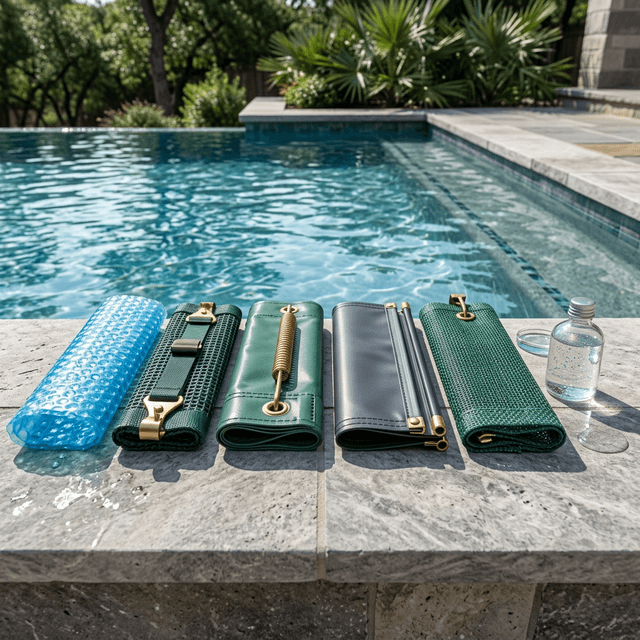
The 6 Types of Pool Covers
Type 1: Solar Covers (Bubble Covers)
What it is: A large sheet of UV-stabilized polyethylene with air bubbles on the underside (like bubble wrap for your pool). Floats directly on the water surface, bubble-side down.
How it works: The bubbles trap a layer of air that insulates the water. The cover also prevents evaporation (the primary source of heat loss) and absorbs solar energy, transferring it to the water.
Cost: $50-$200 for most residential pools (sold by the foot or in standard sizes and trimmed to fit)
Pros:
- Very affordable — the cheapest pool cover option
- Raises water temperature 8-15 degrees F through passive solar heating
- Reduces evaporation by 95%+
- Reduces chemical loss (chlorine doesn't evaporate as fast under a cover)
- Reduces debris entering the pool
- Easy to install — just unroll and place on water
- Can be cut to fit any pool shape
Cons:
- Not a safety cover — children and pets can become trapped underneath
- Lifespan of 2-4 years (UV degrades the material)
- Can be awkward to handle on large pools (heavy when wet)
- Must be removed before swimming and replaced after
- Degrades faster in DFW's intense summer sun
- Can promote algae growth if pool chemistry isn't maintained underneath
- Wind can blow lighter covers off the pool
Best for: Pool owners who want to reduce heating costs and evaporation on a budget. Particularly effective in DFW spring and fall when you want to extend the swimming season without running a heater constantly.
DFW note: Solar covers are highly effective in our climate. The abundant Texas sunshine provides excellent passive heating. However, during peak summer (July-August), you might actually want your pool to cool down — a solar cover in midsummer can push water temperatures into the uncomfortable 90s. Many DFW pool owners use solar covers from March through June and September through November, skipping the hottest months.
Type 2: Mesh Safety Covers
What it is: A strong mesh fabric cover stretched over the pool and anchored to the deck with spring-loaded straps and brass anchors drilled into the surrounding surface. The mesh allows water (rain) to pass through while blocking debris and providing a safety barrier.
How it works: The cover is tensioned across the pool so it can support weight. Mesh safety covers are designed to prevent accidental drowning — they can support the weight of adults and children.
Cost: $1,500-$4,000 installed (custom measured and manufactured to fit your pool)
Pros:
- Safety rated — meets ASTM F1346 standard for pool safety covers
- Rain water passes through (no standing water on top)
- Very strong — supports significant weight
- Long lifespan: 10-15+ years with proper care
- Light enough for one person to install and remove
- Low maintenance — no pump needed on top
- Keeps out large debris (leaves, branches, animals)
- UV resistant and durable
Cons:
- Does not block sunlight — algae can grow underneath if chemicals aren't maintained
- Fine debris (dirt, pollen, dust) passes through the mesh into the pool
- No heat retention — doesn't warm the pool or prevent evaporation
- Doesn't reduce chemical usage significantly
- Requires professional installation for deck anchors
- Takes 15-30 minutes to install/remove
Best for: Families with young children or pets who want safety protection during the off-season. Also ideal for pools surrounded by trees — rain passes through, so leaves sit on top without creating a swamp. Common choice for winter cover in DFW.
DFW note: Mesh safety covers are the most popular winter cover in the DFW area. Since our winters are mild and pools don't freeze solid, many homeowners close their pools from December through February and cover them with mesh covers. The mesh handles our spring storms well — water drains through rather than pooling on top.
Type 3: Solid Safety Covers
What it is: Similar to a mesh safety cover in structure (anchored to the deck with straps and springs) but made of solid vinyl material instead of mesh. Completely blocks water, light, and debris.
How it works: The solid material blocks all sunlight, preventing algae growth. It also prevents evaporation and debris from entering. Because rain and meltwater collect on top, solid safety covers include a submersible pump or drain panel to remove standing water.
Cost: $2,500-$6,000 installed
Pros:
- Safety rated (ASTM F1346)
- Blocks 100% of sunlight — virtually eliminates algae growth while covered
- Blocks all debris, including fine particles
- Reduces evaporation
- Retains heat better than mesh covers
- Pool water stays much cleaner underneath — easier spring opening
- Very durable: 10-15+ year lifespan
Cons:
- Requires a cover pump to remove standing water from the top
- Heavier than mesh — harder for one person to manage
- Cover pump must be monitored (if it fails, water accumulates and can damage the cover)
- More expensive than mesh
- Standing water on top can be a drowning hazard for small children and animals if the pump fails
- Can be damaged by heavy ice or snow loads (less of an issue in DFW)
Best for: Pool owners who want safety plus a clean pool underneath. Ideal if you want minimal work when opening the pool in spring — a pool under a solid cover typically needs just a quick vacuum and chemical adjustment rather than a full cleanup.
DFW note: Solid covers work well in DFW but require more attention to the cover pump due to our spring storms. A heavy rain can dump inches of water on the cover quickly. Make sure your cover pump is in good working order and consider a backup. The advantage is that your pool opening in spring is dramatically easier — no algae, minimal debris.
Type 4: Automatic Pool Covers
What it is: A motorized cover system with a retractable cover that rolls onto a hidden reel. Operated by a key switch, remote, or automation system — press a button and the cover extends across the pool or retracts into a housing.
How it works: A motor drives a reel system that extends or retracts a solid vinyl cover along tracks built into the pool coping or deck. When extended, the cover sits on the water surface.
Cost: $10,000-$25,000+ installed (including track system and motor)
Pros:
- Convenience — covers and uncovers in under 60 seconds with the push of a button
- Safety rated (ASTM F1346) when properly maintained
- Blocks sunlight, preventing algae
- Reduces evaporation by 95%+
- Significant heat retention — reduces heating costs by 50-70%
- Reduces chemical usage by 35-60%
- Keeps out all debris
- Because it's so easy, you'll actually use it daily (unlike manual covers that stay folded on the deck)
- Can be integrated with pool automation systems
Cons:
- Very expensive — the highest upfront cost of any cover type
- Complex mechanical system that requires maintenance
- Motor, reel, and track components can fail and are costly to repair ($500-$2,000+ for motor replacement)
- Cover fabric wears out and needs replacement every 5-8 years ($2,000-$5,000)
- Requires specific pool dimensions and coping design — difficult to retrofit on some pools
- Tracks must be kept clean and free of debris
- Standing water on top requires a cover pump
- Pool shape must be rectangular or near-rectangular (tracks run in straight lines)
Best for: Homeowners who want daily cover use without the hassle. The convenience factor is the key advantage — because auto covers are effortless, people actually use them every day instead of leaving the pool uncovered. Over time, the energy savings, chemical savings, and reduced maintenance partially offset the high cost.
DFW note: Automatic covers are gaining popularity in DFW's high-end new construction. They work exceptionally well in our climate — the daily cover use dramatically reduces evaporation (a major issue in Texas heat), cuts heating costs for year-round swimming, and keeps the pool pristine between uses. The main drawback is the retrofit cost — adding auto-cover tracks to an existing pool requires significant construction. It's much more cost-effective to include an auto cover in a new pool build.
For more on pool automation options, see: Pool Automation Systems Guide
Type 5: Winter Pool Covers (Tarp-Style)
What it is: A basic solid tarp-like cover that drapes over the pool and is held in place by water bags, clips, or weights around the perimeter. This is the most basic and affordable cover option for seasonal closure.
Cost: $75-$400 depending on size and quality
Pros:
- Inexpensive
- Blocks sunlight and most debris
- Easy to find at any pool supply store
- Comes in standard sizes — no custom fabrication needed
Cons:
- NOT a safety cover — will not support weight and can be a drowning hazard
- Water bags and weights can shift, allowing debris and animals in
- Standing water collects on top (needs a cover pump)
- Shorter lifespan: 1-3 seasons
- Wind can lift and shift the cover
- Looks unattractive
- Water bags can break and spill, requiring replacement
Best for: Budget-conscious pool owners who want basic debris and light protection during the off-season. This is the minimum viable cover for a pool that won't be used for several months.
DFW note: Winter tarps work adequately in DFW but can be problematic during our spring windstorms. Water bags shift, the cover flaps, and debris gets underneath. For the relatively short DFW off-season (if you close at all), investing in a mesh safety cover is usually a better long-term value.
Type 6: Liquid Solar Covers
What it is: Not a physical cover at all — it's a chemical product (typically a fatty alcohol like isopropyl myristate) that creates an invisible, microscopically thin layer on the water surface. This layer reduces evaporation.
How it works: You add a small amount of liquid (or drop in a slow-dissolving ball or fish-shaped dispenser) weekly. The product forms a monolayer on the water surface that reduces the rate at which water molecules escape into the air.
Cost: $10-$30 per month (ongoing)
Pros:
- No physical cover to install, remove, or store
- Pool is always swim-ready — nothing to move
- Reduces evaporation by 15-40% (manufacturer claims vary)
- Some heat retention benefit
- Works on any pool shape or size
- Can be used alongside a physical cover for added benefit
- No deck anchors, tracks, or equipment needed
Cons:
- Much less effective than physical covers (15-40% evaporation reduction vs. 95%+)
- No debris protection whatsoever
- No safety benefit
- No light-blocking — doesn't prevent algae
- Ongoing monthly cost adds up over years
- Effectiveness reduced by wind, rain, and heavy swimmer use (which breaks up the surface layer)
- Must be reapplied regularly
Best for: Pool owners who want some evaporation reduction without any physical cover. Works well as a supplement in DFW pools that go through a lot of water in summer. Also a good option for pools with features (waterfalls, fountains, spillovers) that make physical covers impractical.
DFW note: Liquid solar covers are popular in DFW as a summer supplement. During July and August, evaporation can cost DFW pool owners 1-2 inches of water per week (roughly 300-600 gallons for an average pool). A liquid cover won't stop this entirely, but reducing it by 20-30% saves real water and money over the season.
Side-by-Side Comparison
| Feature | Solar Bubble | Mesh Safety | Solid Safety | Automatic | Winter Tarp | Liquid Solar |
|---|---|---|---|---|---|---|
| Cost | $50-$200 | $1,500-$4,000 | $2,500-$6,000 | $10,000-$25,000 | $75-$400 | $10-$30/month |
| Safety rated | No | Yes | Yes | Yes | No | No |
| Evaporation reduction | 95%+ | Minimal | 95%+ | 95%+ | 90%+ | 15-40% |
| Heat retention | Excellent | None | Very good | Excellent | Good | Slight |
| Debris protection | Good | Good (large debris) | Excellent | Excellent | Fair | None |
| Algae prevention | Partial | None (light passes through) | Excellent | Excellent | Good | None |
| Chemical savings | 35-50% | Minimal | 40-60% | 40-60% | 30-40% | 5-15% |
| Ease of use | Moderate | 15-30 min on/off | 15-30 min on/off | Push button | Moderate | Pour and go |
| Lifespan | 2-4 years | 10-15 years | 10-15 years | 5-8 years (fabric) | 1-3 years | N/A (consumable) |
| Works on freeform pools | Yes | Yes (custom) | Yes (custom) | No (rectangular only) | Yes | Yes |
| Needs cover pump | No | No | Yes | Yes | Yes | No |
Energy Savings by Cover Type
Pool covers reduce energy consumption in two primary ways: preventing evaporation (which is the biggest source of heat loss) and directly insulating the water.
Estimated annual savings for a typical DFW pool (15,000 gallons with gas heater)
| Cover Type | Heating Savings | Chemical Savings | Water Savings | Total Annual Savings |
|---|---|---|---|---|
| Solar bubble | $200-$500 | $100-$200 | $50-$100 | $350-$800 |
| Mesh safety | $0-$50 | $25-$50 | $25-$50 | $50-$150 |
| Solid safety | $150-$400 | $150-$250 | $50-$100 | $350-$750 |
| Automatic | $300-$700 | $200-$300 | $75-$150 | $575-$1,150 |
| Liquid solar | $50-$150 | $25-$75 | $25-$75 | $100-$300 |
Note: Savings vary widely based on heater type, usage patterns, pool size, and how consistently the cover is used. The biggest factor is consistency — a cover that's used every day saves dramatically more than one that sits folded on the deck.
For more on reducing pool energy costs, see: Swimming Pool Energy Saving Tips
DFW Climate Considerations for Pool Covers
North Texas has a unique climate that affects pool cover selection:
Intense summer sun and heat
- Solar covers work extremely well for spring/fall but may overheat the pool in midsummer
- UV degrades cover materials faster here than in northern climates — expect the lower end of lifespan estimates
- Automatic covers and solid covers keep the pool significantly cooler when you want them to (shade the water from direct sun)
Severe spring storms and wind
- Mesh safety covers handle rain well — water drains through
- Solid covers and tarps need reliable cover pumps to handle sudden downpours (DFW can get 3-4 inches in a single storm)
- Wind can shift unsecured covers — anchored safety covers and auto covers are more resistant
- Hail can damage solar bubble covers (replace as needed — they're cheap)
Mild winters
- DFW's winter is short and mild (most pools don't freeze solid)
- Many DFW pool owners don't close their pools at all — they just reduce pump runtime and lower chemical doses
- If you do close, the off-season is typically December through February (3 months at most)
- A mesh safety cover is ideal for this short closure period
Year-round evaporation
- Evaporation is a 12-month issue in DFW, not just a summer problem
- Wind increases evaporation significantly — windy days can double the water loss
- Any cover that reduces evaporation saves money year-round
- Liquid solar covers are an easy, no-hassle way to reduce evaporation continuously
High water costs
DFW water rates are rising. Reducing evaporation directly reduces your water bill. Over 5 years, the water savings alone can pay for a solar cover many times over.
Maintenance by Cover Type
Every cover needs some care to reach its full lifespan.
Solar bubble covers
- Rinse with fresh water after removal to prevent chemical buildup
- Store off the ground when not in use (a solar cover reel makes this easy)
- Keep out of direct sun when stored (UV is the enemy)
- Replace when bubbles start popping or the material becomes brittle
Mesh and solid safety covers
- Sweep or blow leaves off the top periodically
- Clean the cover fabric with mild soap and water before storage
- Inspect straps and springs annually — replace worn hardware
- Lubricate brass deck anchors with silicone spray before installing
- For solid covers: keep the cover pump working and clear of debris
Automatic covers
- Keep the tracks clean — debris in tracks is the number one cause of auto-cover failure
- Flush tracks with a garden hose monthly during leaf season
- Check the water level on top and pump off as needed
- Have the motor and reel inspected annually by a professional
- Lubricate the mechanism per manufacturer instructions
- Replace the fabric when it shows significant wear (UV degradation, tears)
Winter tarp covers
- Keep water bags filled but not over-full (they expand in heat)
- Replace cracked or leaking water bags promptly
- Remove standing water from the cover surface with a pump
- Store in a dry location during the off-season
Which Cover Is Right for You?
Use this decision guide based on your priorities:
If safety is your top priority: Mesh safety cover or automatic cover. Both are ASTM rated and prevent accidental drowning. If you have young children or pets, a safety-rated cover is strongly recommended. See: Pool Safety Tips for Families
If reducing heating costs is your top priority: Solar bubble cover (best value) or automatic cover (best performance). Both dramatically reduce evaporation, which is the primary source of heat loss.
If reducing maintenance is your top priority: Automatic cover or solid safety cover. Both block debris and sunlight, meaning less cleaning and fewer chemicals.
If you want the cheapest effective option: Solar bubble cover. For under $200, you get excellent evaporation reduction and passive solar heating.
If you want the best overall (money is not the main constraint): Automatic pool cover. The convenience factor means you'll actually use it daily, maximizing every benefit — safety, heating, chemicals, debris, and evaporation.
If you have a freeform pool: Solar bubble cover (trim to fit), custom mesh/solid safety cover, or liquid solar cover. Automatic covers require rectangular pools.
If you don't want to deal with a physical cover at all: Liquid solar cover. Pour and forget (weekly). You won't get the full benefits, but some reduction in evaporation is better than none.
Get the Right Cover for Your Pool
Simplified Pools carries solar covers, liquid solar covers, and cover accessories at our Northlake store. We can also help you select and install safety covers and connect you with automatic cover specialists for new installations.
- Browse covers and accessories at our store: Simplified Pools Supply Store
- Shop online: Simplified Pools Online Shop
- Talk to us about cover options for your pool: Contact Us
- Call us directly: (469) 455-1054
- Explore our full range of services: Pool Services
Not sure which cover makes sense for your pool? Come by the store or give us a call. We'll ask about your pool size, shape, budget, and priorities, and recommend the cover that gives you the best value.