Pool Winterization in Texas: Do You Need to Close Your Pool for Winter?
Texas pool winterization is a different game than northern states. Most DFW pool owners should NOT fully close their pool for winter. Instead, you should reduce maintenance, protect equipment from freeze events, and keep the system running at lower capacity. Full pool closures with covers, winterizing chemicals, and blown lines are typically unnecessary in North Texas — and can actually cause more problems than they solve.
Here's the Texas-specific approach to winter pool care that protects your investment without overdoing it.
Why Texas Winters Are Different
DFW winter climate reality
- Average winter lows: 30-40°F (December-February)
- Hard freeze events (below 25°F): 3-8 times per winter typically
- Arctic blasts (below 15°F): 0-2 times per winter
- Most winter days have highs above 50°F
- Pool water rarely drops below 45°F
- Many weeks in winter have swimmable days (60-70°F)
Why full closure is usually wrong for Texas
- Stagnant water grows algae — even in cool weather, Texas has enough warm days for algae to establish
- Mosquitoes breed in standing water — not running the pump creates breeding habitat
- Equipment sits idle too long — seals dry out, motors can seize
- You miss warm days — Texas has plenty of nice winter weekends when you'd want to use the pool
- Spring startup is harder — a fully closed pool needs more work to open than one that ran all winter
Texas Winter Pool Care: What to Do
Reduce pump runtime
- Summer: 10-12 hours/day
- Winter: 4-6 hours/day (enough to circulate and filter)
- Variable speed pumps: Lower to the minimum speed that maintains flow through all returns
- Run the pump during the warmest part of the day (10am-4pm) for energy efficiency
Lower chemical usage
- Chlorine consumption drops significantly with cooler water
- Reduce shock frequency to every 2-3 weeks instead of weekly
- Maintain 1-2 ppm free chlorine (lower than summer's 2-4 ppm)
- Keep stabilizer (CYA) at 30-50 ppm — still important for UV protection on sunny winter days
- Continue monitoring pH and alkalinity monthly
Clean less frequently
- Skim as needed (less debris in winter, except live oak leaves which drop in spring)
- Brush every 2 weeks instead of weekly
- Vacuum as needed
- Clean filter every 4-8 weeks instead of every 2-4 weeks
Protect equipment from freezing
This is the critical winter task in Texas. See the freeze protection section below.
Freeze Protection: The Most Important Winter Task
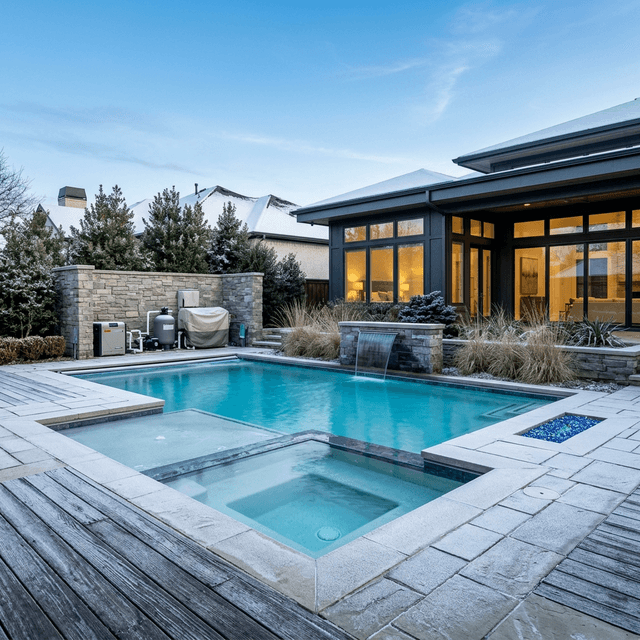
Freeze damage is the number one winter risk for Texas pools. A single hard freeze can crack pumps, filters, heaters, and plumbing — causing thousands of dollars in damage.
How freeze damage happens
- Water expands when it freezes
- Standing water in pipes, pump housings, filters, and heaters cracks the housing
- Equipment on elevated pads is most vulnerable (exposed to cold air on all sides)
- Underground plumbing rarely freezes in DFW (ground insulates it)
- Above-ground equipment and exposed pipes are the main risk
Automatic freeze protection
Most modern pool automation systems (Pentair, Hayward, Jandy) have freeze protection built in:
- A sensor detects when air temperature drops near freezing (typically 36-38°F)
- The system automatically turns on the pump and any aux equipment
- Moving water through the pipes prevents freezing
- The pump continues running until the temperature rises above the threshold
CRITICAL: Make sure your freeze protection is enabled and working BEFORE the first freeze of the season. Test it in October/November.
If you DON'T have automation
You must manually protect your equipment during freeze events:
Option 1: Run the pump continuously
- Turn the pump on before the freeze arrives
- Run it continuously until temperatures rise above 32°F
- Moving water won't freeze in the pipes
Option 2: Drain and winterize equipment (severe freeze only) If you can't run the pump (power outage risk, equipment issues):
- Turn off the pump and heater
- Remove drain plugs from the pump, filter, heater, and chlorinator
- Open the air relief valve on the filter
- Blow out exposed pipes with a shop vac if possible
- Place pool noodles or water bottles in skimmers to absorb ice expansion
- Cover exposed equipment with insulation blankets
Freeze protection checklist
- Test freeze protection sensor (press the override to verify pump turns on)
- Inspect freeze protection wiring and sensor
- Verify all equipment turns on when freeze protection activates
- Check that heater also starts during freeze protection (if applicable)
- Ensure pool water level is at proper height (low water = pump can't prime)
- Trim any branches near exposed pipes that could break and damage plumbing
- Have drain plugs easily accessible in case of power failure
- Keep our emergency number handy: (469) 455-1054
After a freeze event
Inspect equipment for damage:
- Check pump housing for cracks (especially the volute)
- Look for leaking filter housing
- Inspect heater connections and heat exchanger
- Check PVC pipe connections for cracks
- Look for water dripping from any equipment
If you find freeze damage, call us immediately at (469) 455-1054. Quick repair prevents water damage to the equipment pad and surrounding area. See our repair services.
Products That Help
Freeze protection sensor — if your system doesn't have one, we can install an aftermarket freeze protection kit. Essential for DFW winters. Contact us for installation.
Pipe insulation — foam pipe insulation for exposed above-ground plumbing. Available at hardware stores and our Northlake store.
Pool antifreeze (for severe winterization only) — non-toxic propylene glycol antifreeze rated for pool equipment. Only needed if fully winterizing or for specific equipment protection. Available at our store.
Equipment blankets — insulation blankets designed for pool pumps and heaters. Available at our store.
Skimmer guards (Gizzmos) — absorb ice expansion in the skimmer throat, preventing cracks. Available at our store.
Winter Service Plans
Our weekly maintenance plans adjust automatically for winter:
- Reduced visit frequency (biweekly instead of weekly for Chemical-Only plan)
- Freeze protection monitoring — we verify your system is armed before every cold front
- Emergency response — if freeze damage occurs, we're on it fast
- Chemistry management — we adjust chemical dosing for cooler water
- Equipment inspection — we check for freeze damage after every cold event
Winter service ensures your pool is protected and ready to swim on those beautiful Texas winter afternoons.
Plans start at $165/month. Get your free quote or call (469) 455-1054.
Don't let a Texas freeze destroy your pool equipment. Simplified Pools provides year-round protection for Northlake, Argyle, Flower Mound, Trophy Club, and all DFW North. Contact us today.