Pool Algae Types: Green, Yellow, Black — Identification, Treatment & Prevention
Algae is every pool owner's nightmare, but not all algae is created equal. Green algae is the easiest to treat, yellow (mustard) algae is stubborn and misdiagnosed, and black algae is the hardest to kill because it grows roots into your plaster. Using the wrong treatment for the wrong algae type wastes time and money while the problem gets worse.
Here's how to identify exactly what type of algae you're dealing with and the specific treatment each one requires.
Green Algae: The Most Common Pool Algae
Identification
- Color: Bright green to dark green
- Texture: Slimy, slippery coating on walls and floor
- Location: Everywhere — walls, floor, steps, behind ladders, in corners
- Water appearance: Ranges from slightly hazy/green tint to completely opaque green
- Growth speed: Fast — can turn a pool green in 24-48 hours in Texas summer
What causes green algae
- Free chlorine drops below 1 ppm
- pH above 7.8 (reduces chlorine effectiveness)
- Poor circulation or dead spots
- Dirty filter allowing algae to pass through
- Heavy rain diluting chemicals
- Phosphates providing food source
Treatment for green algae
Mild green (can still see the bottom):
- Brush all pool surfaces thoroughly
- Shock with 2 lbs calcium hypochlorite per 10,000 gallons
- Run pump 24/7 until water clears
- Add algaecide after shocking
- Clean filter daily during treatment
- Retest and maintain 5+ ppm chlorine until completely clear
Moderate green (can't see past 3 feet):
- Brush all surfaces
- Shock with 3-4 lbs cal-hypo per 10,000 gallons
- Run pump 24/7
- Add polyquat algaecide
- Vacuum dead algae to waste (not through filter)
- Clean filter 2-3 times during treatment
- Maintain 10+ ppm chlorine for 48 hours
Severe green (can't see past 1 foot / opaque):
- Consider calling a professional — our Green-to-Clean service handles this
- If DIY: Shock with 4-5 lbs cal-hypo per 10,000 gallons
- Run pump 24/7 for 3-7 days
- Vacuum to waste daily
- Clean or backwash filter multiple times daily
- Maintain 15+ ppm chlorine continuously
- May need multiple rounds of shocking
Timeline: Mild green clears in 1-3 days. Moderate in 3-5 days. Severe in 5-10 days.
Cost: DIY $100-$300 in chemicals. Professional Green-to-Clean: $300-$800.
Yellow (Mustard) Algae: The Sneaky One
Identification
- Color: Yellowish-green, tan, or mustard-colored
- Texture: Powdery, sandy feel — brushes off easily but comes right back
- Location: Prefers shaded areas — shady walls, under steps, behind ladders, north-facing walls
- Water appearance: Water may look relatively clear — mustard algae doesn't cloud water as much as green algae
- Growth speed: Slow but persistent. Returns within days of brushing
Why mustard algae is tricky
- Often misdiagnosed as dirt, pollen, or sand
- Chlorine-resistant — normal chlorine levels (2-4 ppm) don't kill it
- Lives outside the pool — can survive on pool toys, equipment, swimsuits, brushes, and nets
- Comes back repeatedly if not treated aggressively with everything at once
How to tell it's mustard algae (not dirt)
- Brush the discoloration off the wall
- If it brushes off easily in a cloud but returns within 24-48 hours to the same spot, it's mustard algae
- Dirt stays on the bottom; mustard algae climbs walls
- If it's only in shaded areas, it's almost certainly mustard algae
Treatment for mustard algae
Mustard algae requires an aggressive, all-at-once approach. Half-measures let it survive and return.
Complete treatment protocol:
Day 1 — Preparation:
- Remove all pool toys, floats, cleaning equipment, and swimsuits from the pool area
- Wash all pool toys and swimsuits in a bleach solution (1 cup bleach per gallon of water) or run swimsuits through the washing machine with bleach
- Soak pool brush, net, vacuum head in bleach solution
- Clean your filter thoroughly (backwash, clean cartridge, or perform DE teardown)
Day 1 — Treatment: 5. Brush every surface of the pool — walls, floor, steps, behind ladders, inside skimmers 6. Triple-shock the pool: 3 lbs calcium hypochlorite per 10,000 gallons 7. Add a mustard algae-specific algaecide (sodium bromide-based products are most effective) 8. Run the pump 24/7 9. Raise chlorine to 15-20 ppm and maintain it there
Days 2-3: 10. Brush all surfaces again daily 11. Maintain chlorine at 15+ ppm — add more shock as needed 12. Clean the filter daily 13. Vacuum dead algae to waste
Days 4-7: 14. Continue maintaining high chlorine 15. Brush every other day 16. Once water is completely clear and chlorine holds at 5+ ppm without dropping rapidly, the algae is dead 17. Add a preventive dose of algaecide 18. Return to normal chlorine maintenance
Timeline: 5-10 days for complete eradication.
Key: You MUST maintain extreme chlorine levels (15+ ppm) for several days. Normal chlorine won't kill mustard algae.
Black Algae: The Hardest to Kill
Identification
- Color: Dark blue-green to black spots
- Texture: Rough, bumpy nodules that feel like they're embedded in the plaster
- Location: Typically on rough surfaces — plaster walls, concrete, grout lines in tile. Rarely on smooth surfaces like fiberglass or vinyl
- Size: Starts as small dark spots (dime-sized), grows into larger clusters
- Growth speed: Very slow but extremely persistent
Why black algae is so difficult
- Protective outer layer — Black algae forms a waxy coating that repels chlorine and other chemicals
- Root system — Unlike other algae that grow on surfaces, black algae sends roots (rhizoids) into the pores of plaster and concrete
- Chlorine resistant — The protective layer makes it virtually immune to normal chlorine levels
- Regrows from roots — If you kill the surface but not the roots, it comes right back
Treatment for black algae
Important: Black algae treatment is aggressive and may be best handled by a professional, especially in plaster pools where you want to minimize surface damage.
Treatment protocol:
- Lower pH to 7.0-7.2 — Acid enhances chlorine's killing power
- Brush affected spots with a stainless steel brush — This breaks open the protective waxy layer. A nylon brush won't cut it
- Apply granular chlorine (cal-hypo) directly to each spot — Turn off the pump, let granules sink onto the spots
- Let it sit for 30-60 minutes with pump off
- Brush again — aggressive brushing to push chlorine into the root structure
- Triple-shock the entire pool — 3-4 lbs cal-hypo per 10,000 gallons
- Add algaecide — Copper-based algaecide is most effective against black algae (though use cautiously as copper can stain)
- Run pump 24/7 for 5-7 days
- Repeat brushing and spot-treating daily for at least a week
- Maintain chlorine at 15+ ppm throughout treatment
For severe cases:
- Acid washing the affected area may be necessary
- Replastering may be the only permanent solution if roots are deeply embedded
- Professional treatment recommended
Timeline: 1-4 weeks for complete treatment. May require multiple treatment cycles.
Prevention after treatment: Monthly algaecide treatments and vigilant chlorine maintenance. Any small dark spot that appears should be brushed and spot-treated immediately.
Products That Help Fight Algae
Pool shock (calcium hypochlorite) — the primary weapon against all algae types. Professional-grade shock is more concentrated and effective than consumer products. Available at our Northlake store and online shop.
Algaecide (polyquat 60) — best general-purpose preventive algaecide. Won't stain or foam. Use weekly as prevention. Available at our store.
Mustard algae treatment (sodium bromide) — specifically formulated for yellow/mustard algae. Converts to bromine in the presence of chlorine, which mustard algae can't resist. Available at our store.
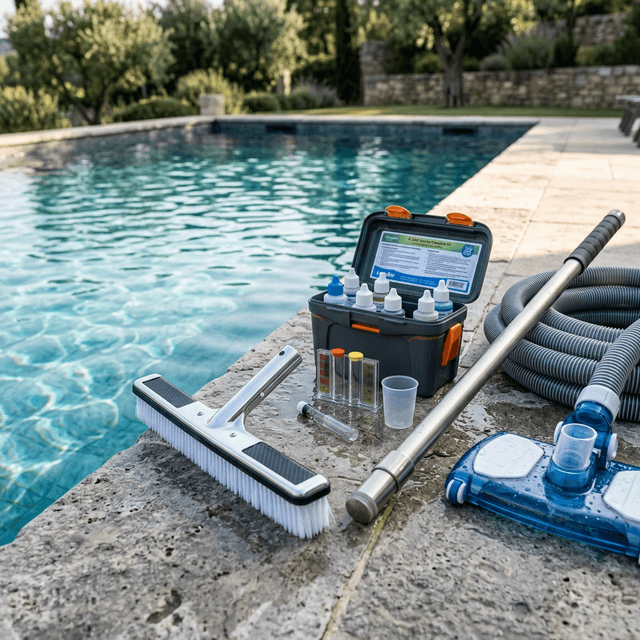
Stainless steel pool brush — essential for black algae treatment. Breaks through the protective layer. Do NOT use on fiberglass or vinyl pools. We carry professional stainless brushes at our store.
Phosphate remover — eliminates algae's primary food source. If phosphates are above 500 ppb, treatment dramatically reduces algae recurrence. Available at our store and online.
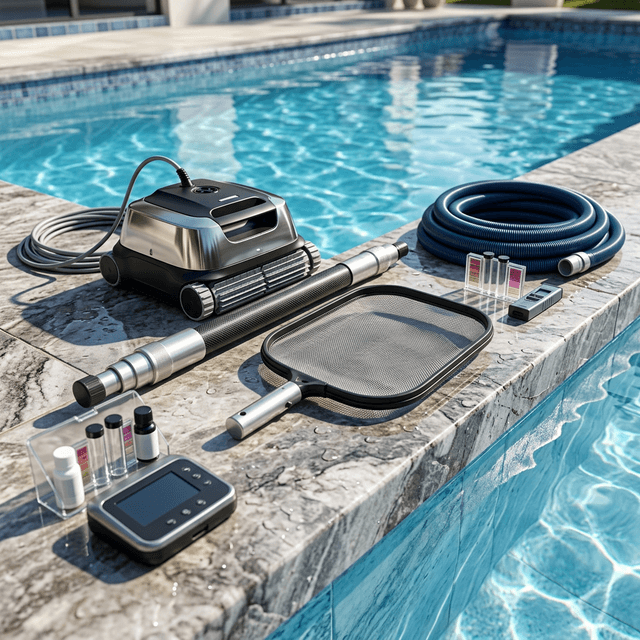
Pool vacuum — for removing dead algae. Vacuum to waste when possible to prevent clogging your filter. See our vacuum and cleaner selection.
Preventing Algae in Texas
Texas heat, UV, and long pool seasons make algae prevention essential:
- Maintain chlorine at 2-4 ppm — never let it drop below 1 ppm
- Use stabilizer (CYA) at 30-50 ppm — protects chlorine from UV
- Brush weekly — prevents biofilm that algae colonizes
- Run pump 10-12 hours daily in summer
- Clean filter regularly — a dirty filter can't remove algae spores
- Use algaecide weekly as prevention
- Shock weekly during peak summer
- Treat phosphates — keep below 500 ppb
- Fix dead spots — areas with poor circulation are algae magnets
- Address problems immediately — a small green tint today becomes a fully green pool in 48 hours
When to Call a Professional
- Black algae — professional treatment recommended due to aggressive methods needed
- Recurring algae — if algae keeps coming back despite treatment, there's likely a circulation, filtration, or chemical management issue that needs professional diagnosis
- Severe green pool — our Green-to-Clean service starts at $300 and handles the entire process
- Pool hasn't been maintained — if a pool has been neglected for weeks or months, professional restoration is faster and cheaper than DIY attempts
Our weekly maintenance plans prevent algae from ever getting started. Starting at $165/month. Get your free quote or call (469) 455-1054.
Algae doesn't stand a chance with Simplified Pools. We serve Northlake, Argyle, Flower Mound, Trophy Club, Justin, Roanoke, and all DFW North communities. Contact us for professional algae treatment or prevention.