How to Open Your Pool for Summer in Texas: Complete Startup Guide
Texas pool season starts earlier than most of the country. Most DFW pool owners should begin their spring startup process in March or early April, when water temperatures start climbing above 60°F. Waiting too long invites algae growth that's harder and more expensive to deal with once temperatures hit the 80s.
Here's the complete step-by-step process for opening your pool in Texas — whether you winterized properly or let it sit all winter.
When to Open Your Pool in DFW
Ideal timing: March 1 - April 15
Why opening early matters in Texas:
- Algae begins growing at water temperatures above 60°F
- DFW water temperatures can hit 60°F by mid-March
- Starting chemicals and filtration early prevents green pool situations
- Pool equipment issues are easier to fix when demand for service techs is lower (before May rush)
- Getting ahead of the season means you're swim-ready when warm weather arrives
If you wait until May, you'll compete with every other pool owner for service appointments and may face algae problems that developed during the warm April weeks.
Step-by-Step Pool Opening Process
Step 1: Remove and Clean the Cover (If Applicable)
Many Texas pool owners don't use winter covers due to mild winters, but if you do:
- Pump standing water off the cover using a submersible pump or siphon
- Remove leaves and debris from the cover surface
- Carefully remove the cover — two people makes this easier
- Clean the cover with a garden hose and mild cleaner before storing
- Let it dry completely to prevent mold and mildew
- Fold and store in a cool, dry place
Step 2: Inspect and Reconnect Equipment
Before turning anything on:
- Visual inspection — Look at the pump, filter, heater, and all plumbing for visible cracks, leaks, or damage
- Drain plugs — If you removed drain plugs during winterization, reinstall them now (pump, filter, heater, chlorinator)
- Valves — Open all suction and return valves to the normal operating position
- Skimmer baskets — Remove any winterizing plugs or Gizzmos and reinstall baskets
- Pump strainer basket — Check it's clean and properly seated
- Electrical connections — Inspect for any rodent damage to wiring (common in Texas)
Step 3: Fill the Pool to Proper Level
If the water level dropped over winter:
- Fill to the middle of the skimmer opening using a garden hose
- In DFW, filling 1-3 inches typically takes 1-4 hours depending on hose flow
- Don't overfill — water needs to be at the midpoint of the skimmer for proper surface skimming
Step 4: Prime and Start the Pump
- Open the pump lid and fill the strainer basket housing with water from a hose
- Close the lid and tighten
- Open the air relief valve on top of the filter
- Turn on the pump
- Watch for water to flow through the sight glass (if equipped)
- Close the air relief valve once water sprays out (air is purged)
- Listen for abnormal sounds — grinding, screeching, or excessive vibration
If the pump won't prime:
- Check water level (must be at skimmer level)
- Check for air leaks at the pump lid O-ring
- Make sure all valves are open
- Try turning off and re-priming several times
Step 5: Clean the Pool
Before balancing chemistry, get the physical debris out:
- Skim the surface — Remove all floating debris
- Brush all surfaces — Walls, floor, steps, and behind ladders. This loosens biofilm and algae spores
- Vacuum the floor — If there's significant debris, vacuum to waste (bypassing the filter) to prevent clogging
- Clean the skimmer basket and pump strainer basket
- Clean or backwash the filter — Start the season with a clean filter
Step 6: Test and Balance Water Chemistry
This is the most critical step. Test everything and balance in this order:
1. Test these parameters:
- pH (ideal: 7.2-7.6)
- Total alkalinity (ideal: 80-120 ppm)
- Free chlorine (ideal: 2-4 ppm)
- Cyanuric acid / stabilizer (ideal: 30-50 ppm)
- Calcium hardness (ideal: 200-400 ppm)
- Total dissolved solids (under 2,500 ppm)
2. Balance in this order:
- Total alkalinity first — This stabilizes pH. Add sodium bicarbonate to raise, muriatic acid to lower
- pH second — Adjust after alkalinity is set. Muriatic acid to lower, soda ash to raise
- Calcium hardness — Add calcium chloride to raise. To lower, partial drain and refill
- Cyanuric acid (stabilizer) — Add conditioner/stabilizer to reach 30-50 ppm. This protects chlorine from UV
- Chlorine last — Shock the pool with 2-3 lbs of calcium hypochlorite per 10,000 gallons (or equivalent liquid chlorine)
3. Run the pump for 24 hours after adding chemicals to circulate and distribute evenly.
4. Retest after 24 hours and make fine adjustments.
Step 7: Shock the Pool
Spring startup always requires a heavy shock:
- Use 2-3x the normal shock dose — winter water has accumulated organic matter and possible algae spores
- Shock at dusk — UV destroys chlorine, so shocking in the evening gives it the overnight hours to work
- Run the pump overnight — full circulation while shock is working
- Don't swim until free chlorine drops below 5 ppm (typically 24-48 hours after shocking)
Step 8: Add Preventive Chemicals
After initial balancing and shocking:
- Algaecide — A preventive dose helps keep algae away during the transition from cold to warm water
- Phosphate remover — If phosphates are above 500 ppb, treat now before warm weather makes algae growth explosive
- Scale inhibitor — Especially important in DFW's hard water. Start monthly sequestrant treatment from day one
- Clarifier — If water is hazy after shocking, a dose of clarifier helps the filter catch fine particles
Step 9: Equipment Check and Optimization
Now that everything is running:
- Check for leaks around pump, filter, heater connections, and plumbing
- Test the heater — Turn it on and verify it ignites and heats properly
- Inspect the salt cell (if applicable) — Clean with mild acid solution if it has scale buildup
- Check automation system — Verify schedules, programming, and sensor readings
- Test pool light — Turn it on and check for moisture inside the lens (indicates a seal failure)
- Inspect the pool cleaner — Replace worn parts (tires, diaphragms, bags)
Products You'll Need for Pool Opening
Here's your spring startup shopping list. We stock everything at our Northlake store and online shop:
Chemicals:
- Pool shock (calcium hypochlorite or liquid chlorine)
- Muriatic acid (pH adjustment)
- Sodium bicarbonate (alkalinity adjustment)
- Cyanuric acid / stabilizer
- Algaecide (preventive)
- Phosphate remover
- Scale inhibitor / sequestrant
- Clarifier
Test supplies:
- Test strips or liquid test kit
- Bring a water sample to our store for free professional water testing
Maintenance supplies:
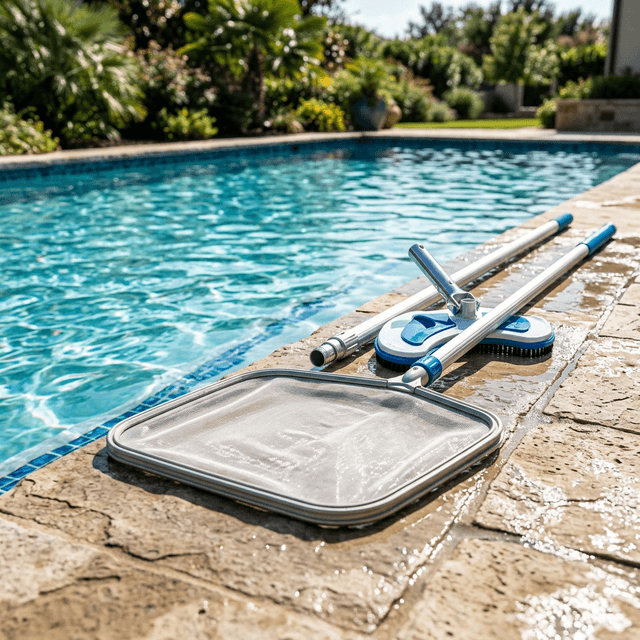
- Pool brush
- Skimmer net
- Vacuum hose and head (or robotic cleaner)
- Filter cleaner
- Replacement O-rings and gaskets
Equipment:
- Replacement filter cartridge or sand (if due)
- New pressure gauge (if yours is stuck or broken)
- Pump basket (if cracked)
Visit our pool supply store at 1611 Commons Cir Suite 100, Northlake, TX 76226 for everything you need. Open Mon-Fri 8am-5pm, Sat 9am-2pm.
Common Spring Startup Problems in DFW
Pool is green after winter
This happens if the pool wasn't properly winterized or was neglected. See our detailed guide: How to Fix a Green Pool in Texas.
Quick version: Heavy shock (3-4x normal), run pump 24/7, brush daily, clean filter frequently. Or call us for our Green-to-Clean service starting at $300.
Pump won't start after sitting all winter
- Check the breaker
- Check the timer
- Try manually rotating the motor shaft (it may be seized from sitting). Use a wrench on the back of the motor to turn it
- If the motor hums but won't spin, the capacitor may be dead ($50-$100 replacement)
- If nothing at all, the motor may need replacement
Stains appeared over winter
Staining from metals (iron, copper, manganese) is common when water chemistry wasn't maintained over winter. Metal stain removers (ascorbic acid based) can treat surface stains. We carry stain treatment products at our store.
Equipment is leaking
Winter freeze damage can crack pump housings, filter tanks, and plumbing. Even in Texas, we get enough freeze events to cause damage. If you see cracks or leaks, call us at (469) 455-1054 for repair service.
Let Us Handle Your Pool Opening
Pool opening takes 2-4 hours of work and multiple trips to rebalance chemistry. If you'd rather just jump in, our team handles the entire process:
- Full spring startup service: Equipment inspection, cleaning, chemistry balancing, shock treatment
- Green pool rescue: If it's already gone green, our Green-to-Clean service gets it swim-ready fast
- Ongoing weekly maintenance: From $165/month, we handle everything so you never worry about pool chemistry again
Schedule your spring pool opening or call (469) 455-1054. We serve all DFW North communities.
Simplified Pools provides professional pool opening, maintenance, and repair across Northlake, Argyle, Flower Mound, Trophy Club, Justin, Roanoke, and all DFW North communities. Get your free quote today.