We get the call at least once a week. Sometimes it's panicked: "My pool is GREEN. My in-laws are coming Saturday. HELP." Sometimes it's sheepish: "I may have... not looked at my pool for a few weeks."
No judgment. It happens. Vacation, busy month, equipment failure, whatever the reason — your pool is green and you need it fixed. Here's exactly how we do it, and how you can do it yourself if you want to tackle it.
First: How Bad Is It?
Not all green pools are the same. Before you do anything, figure out what you're dealing with.
Level 1 — Light Green / Hazy Green You can still see the bottom (barely). Water has a green tint. This is early algae — usually just a few days old. Easiest to fix.
Typical cause: Chlorine dropped to zero for 2-3 days. Maybe your salt cell stopped producing, or you ran out of tablets and didn't notice.
Fix time: 24-36 hours.
Level 2 — Solid Green Can't see the bottom. Water is opaque green, like pea soup. This is a full algae bloom — probably 5-10 days without proper chlorine.
Typical cause: Extended chlorine depletion, often combined with high CYA (which makes what little chlorine you have ineffective).
Fix time: 36-48 hours.
Level 3 — Dark Green / Black Green The water is dark green or has a blackish tint. You can't see 6 inches below the surface. There may be visible algae growth on the walls. This pool has been neglected for weeks.
Typical cause: Equipment failure or complete maintenance neglect. Often accompanied by clogged filters and failing equipment.
Fix time: 48-72 hours, sometimes longer. May need a drain-and-refill if it's severe enough.
The Process: Hour by Hour
Here's what we actually do. This isn't theoretical — it's what we did last Tuesday on a Level 2 green pool in Trophy Club.
Hour 0: Assessment and Prep
Before we touch the water, we check the equipment.
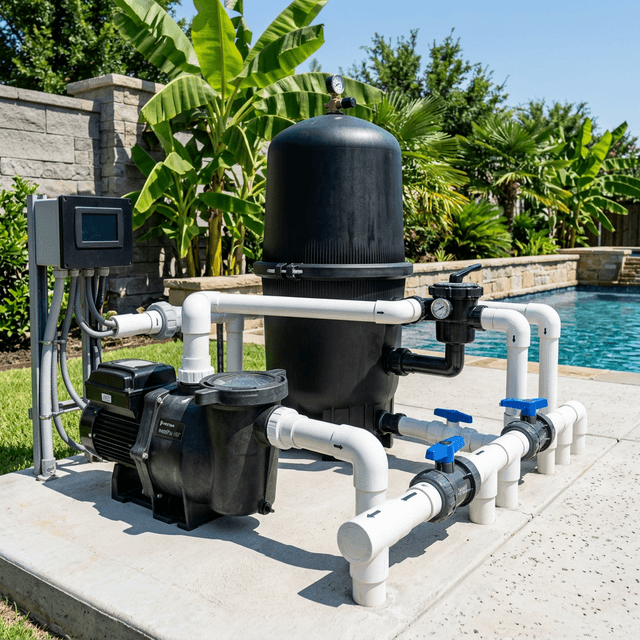
Is the pump running? If not, nothing else matters. We need circulation. Fix the pump first. (Pump troubleshooting guide if it's making noises.)
Is the filter functional? Check the pressure. If it's sky-high, we need to backwash or clean it before we start. A clogged filter can't remove dead algae. (Filter guide)
What's the water level? Needs to be at the middle of the skimmer opening. Too low and the pump sucks air. Too high and the skimmer can't skim.
Hour 0: Water Test
This is the step most people skip — and it's the most important one.
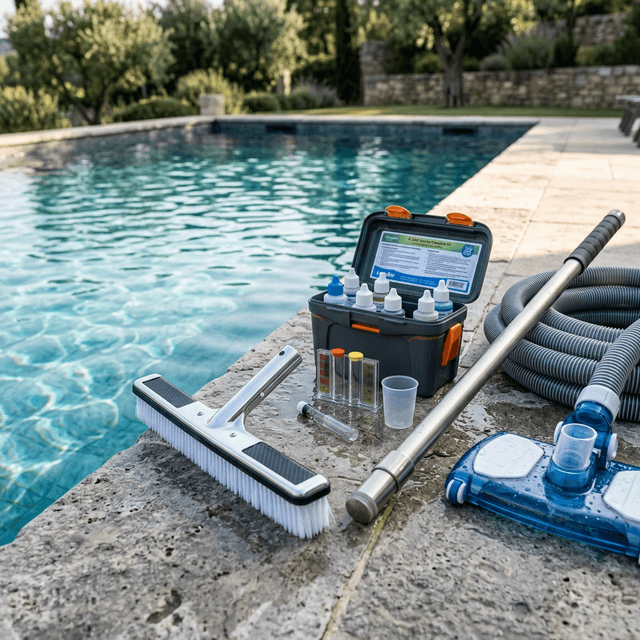
We test:
- Free chlorine: It'll be 0 or near 0. Obviously.
- pH: Needs to be 7.2 or below for the shock to work at maximum effectiveness. We add muriatic acid if pH is above 7.2.
- CYA: This is the sleeper. If CYA is above 50 ppm, we need to shock MUCH harder than the standard recommendation. At CYA 80+, we might be talking 4-5x the normal shock dose. (Why CYA matters)
- Alkalinity: We note it but don't adjust yet. Alkalinity will shift during treatment.
Hour 1: The Shock
Now we hit it. Hard.
The amount matters. Most pool shock bags say "1 pound per 10,000 gallons." That's a maintenance dose for a slightly cloudy pool. For a green pool, you need to reach "breakpoint chlorination" — the level where chlorine overwhelms all the organic demand in the water and starts killing aggressively.
For a typical 15,000-gallon DFW pool:
| Green Level | Target FC | Amount of Liquid Chlorine (12.5%) |
|---|---|---|
| Level 1 (light green) | 10-15 ppm | 1-1.5 gallons |
| Level 2 (solid green) | 20-30 ppm | 2-3 gallons |
| Level 3 (dark green) | 30-40+ ppm | 3-5 gallons |
We use liquid chlorine (sodium hypochlorite), not granular shock. Liquid is faster-acting and doesn't add CYA to water that probably already has too much.
We pour it around the perimeter with the pump running, focusing extra near dead spots and corners.
Important: If CYA is high, you need even more. The SWG/CYA chart says that at 80 ppm CYA, you need a free chlorine level of 31 ppm to reach shock level. At 100 ppm CYA, you need 39 ppm. This is why CYA management matters so much. Our water tends to run high on CYA here in DFW if you're using tablets.
Hours 1-4: Brush Everything
While the shock is circulating, we brush. Every surface. Walls, floor, steps, behind ladders, inside the skimmer throat.
Why? Algae anchors itself to surfaces. Brushing breaks the algae's grip and exposes it to the chlorine in the water. If you skip brushing, the chlorine has to penetrate the algae's biofilm on its own — that takes much longer and uses much more chemical.
This is the part where your arms get tired. It's real work. A full brush of a typical pool takes 20-30 minutes and you'll feel it the next day.
Hours 4-12: Run the Filter. Don't Stop.
The pump runs 24/7 until this is over. Not 8 hours. Not 12 hours. Continuously.
The filter is doing the heavy lifting now. The chlorine killed the algae; the filter removes the dead cells from the water. Dead algae makes the water cloudy — that's normal. The cloudiness goes from green to gray/white as the algae dies. That's a good sign.
If you have a DE or cartridge filter: You'll likely need to clean it 2-3 times during this process. Dead algae clogs filters fast. When pressure rises 8-10 psi above clean, stop and clean.
If you have a sand filter: Backwash when pressure rises. You'll probably backwash 3-4 times over the next two days.
Hour 12: Re-Test and Re-Dose
Test chlorine again. If it's dropped below 5 ppm, the water is consuming chlorine faster than you added it. Add more. You want to maintain at least 5-10 ppm of free chlorine throughout the process.
This is the part where people give up. "I already shocked it!" Yes, but the organic demand was so high that the algae ate your chlorine. Add more. This is a war of attrition.
Hour 24: The Turning Point
By now, the water should be shifting. Green to gray-green to cloudy white. If it's still bright green, your chlorine isn't staying ahead of the demand. More shock. Check CYA — if it's crazy high (100+), you might need a partial drain-and-refill before the chlorine can work.
If the water is cloudy white/gray — you're winning. The algae is dead. Now you're just filtering out the dead cells.
Add clarifier. A good clarifier (we use and sell polyaluminum chloride-based formulas at our store) helps the dead algae clump together into particles large enough for your filter to grab. This speeds up the clearing process significantly.
Hours 24-48: Filter, Clean, Repeat
Keep the pump running. Keep cleaning the filter every time pressure rises. Test chlorine twice a day and maintain 5+ ppm.
The water gets progressively clearer. Cloudy white to hazy blue to clear. You'll see the bottom start to appear. That's the finish line coming.
Hour 48: The Final Push
Test everything:
- Free chlorine: Should be 3-5 ppm and holding (not dropping)
- pH: Adjust back to 7.4-7.6 (it probably drifted during treatment)
- Alkalinity: Adjust if needed
- Filter: One final clean
If the water is clear and holding chlorine — you're done. Your pool is back.
The Costs: DIY vs. Professional
Let's be straight about what this costs either way.
DIY cost for a Level 2 green pool:
- Liquid chlorine (3-5 gallons): $15-25
- Muriatic acid (if needed): $8-12
- Clarifier: $10-15
- Test kit if you don't have one: $20-40
- Total: $50-90 in chemicals
- Plus: 3-5 hours of your time over two days
Professional green-to-clean service:
- Simplified Pools charges $250-500 depending on severity
- We bring all chemicals, do all the labor, return for follow-up visits
- You don't have to think about it
Both are valid choices. If you enjoy pool work and have the time, DIY saves money. If you want it handled, we're here.
Why It Went Green (So It Doesn't Happen Again)
The green was a symptom. You need to fix the cause:
- Chlorine ran out? Set up a reminder system. Weekly maintenance checklist.
- Salt cell stopped producing? Get it inspected and cleaned.
- CYA too high? Switch to liquid chlorine and do a partial drain.
- Filter failing? Replace it.
- Just... life got busy? That's what weekly service is for. $165/month, we handle everything.
Need Help Now?
If your pool is green right now and you want it fixed fast, call us. We do green-to-clean service across Northlake, Argyle, Flower Mound, Trophy Club, Denton, Highland Village, Lewisville, Southlake, and surrounding areas.
(469) 455-1054 or get a quote online
Need chemicals for a DIY rescue? Our Northlake store has everything — liquid chlorine, muriatic acid, clarifier, test kits. We'll even tell you exactly how much to use for your pool size. No charge for the advice.