How to Fix a Green Pool Fast: Step-by-Step Texas Guide
A green pool is not just ugly — it's a health hazard and a problem that gets exponentially worse the longer you wait. The green color comes from millions of algae cells multiplying in your water. In Texas summer heat, a pool can go from a slight green tint to an opaque swamp in 48-72 hours. The good news: most green pools can be cleared in 3-7 days with the right approach. The bad news: the wrong approach wastes time, money, and chemicals while the algae keeps winning.
Here's the step-by-step process for fixing a green pool in DFW, including how to assess severity, the exact chemicals and doses you need, and what to expect during recovery.
Why Pools Turn Green
Algae is always present in your pool environment — spores blow in on the wind, wash in with rain, and arrive on swimsuits and pool toys. Under normal conditions, proper chlorine levels kill algae before it can establish itself. A pool turns green when conditions allow algae to multiply faster than your sanitizer can kill it.
The most common causes in DFW
- Chlorine dropped to zero — the single most common cause. Pump failure, empty chemical feeder, forgotten maintenance, or a vacation without a pool sitter
- High CYA levels — cyanuric acid above 70-100 ppm locks up chlorine and makes it ineffective, even when test readings show "normal" free chlorine. Extremely common in DFW pools using stabilized tablets. See our CYA guide
- Heavy rain — DFW spring storms can dump enough water to dilute chemicals below effective levels
- Equipment failure — pump stopped, filter clogged, salt cell failed, or chemical feeder ran dry
- Neglect after closing for winter — some DFW homeowners stop maintaining their pool in fall, leading to a green swamp by spring
- Pool party followed by no maintenance — heavy bather load consumes all available chlorine
- Power outage — pump not running means no circulation and no filtration
- pH too high — above 7.8, chlorine effectiveness drops dramatically. DFW water naturally trends alkaline
Why Texas makes green pools worse
- Heat accelerates algae growth — algae thrives in warm water. DFW pool water reaches 85-95 degrees F in summer, which is ideal for algae reproduction
- Intense UV — while UV kills some surface algae, it also destroys chlorine rapidly, leaving the pool unprotected
- Long pool season — DFW pools are vulnerable to algae from March through November (9+ months)
- High CYA epidemic — stabilized trichlor tablets are the most popular chlorine source in Texas, and they build CYA relentlessly
- Hard water — DFW's high calcium and alkalinity can interfere with treatment and cloud water even after algae is killed
Assessing Severity: How Green Is Your Pool?
The severity of your green pool determines the approach, chemical doses, timeline, and whether DIY treatment is realistic.
Level 1: Light Green (Can See the Bottom)
What it looks like:
- Water has a green or teal tint
- You can still see the pool floor, at least in the shallow end
- Walls may feel slightly slippery
- Chlorine test reads zero or near-zero
Difficulty: Easy DIY fix Timeline: 1-3 days Chemical cost: $20-$50
Level 2: Moderate Green (Can See 2-3 Feet Deep)
What it looks like:
- Distinctly green water, like green Kool-Aid
- Can see 2-3 feet into the water but not the deep end floor
- Walls are slippery
- Green film on surfaces
- Chlorine reads zero
Difficulty: Moderate DIY fix Timeline: 3-5 days Chemical cost: $40-$80
Level 3: Dark Green (Cannot See Past 1-2 Feet)
What it looks like:
- Dark green, opaque water
- Cannot see more than 1-2 feet deep
- Thick green coating on all surfaces
- Strong musty or earthy smell
- Possible visible floating algae clumps
Difficulty: Advanced DIY or professional recommended Timeline: 5-10 days Chemical cost: $80-$150+
Level 4: Black-Green / Swamp (No Visibility)
What it looks like:
- Black-green or dark brownish-green water with zero visibility
- Looks like a pond or swamp
- Thick organic matter on surfaces and bottom
- May have frogs, tadpoles, or mosquito larvae
- Strong smell
- Pool has likely been neglected for weeks or months
Difficulty: Professional recommended Timeline: 7-14+ days (DIY) or 3-5 days (professional with commercial equipment) Chemical cost: $150-$300+ (DIY) or $300-$600 (professional service)
The SLAM Method: The Right Way to Clear a Green Pool
SLAM stands for Shock, Level, And Maintain. It's the proven method used by pool professionals to kill all algae, clear the water, and prevent regrowth. Unlike simply dumping in shock and hoping for the best, the SLAM method is a systematic process that works.
The core principle
Raise free chlorine to a high "shock level" and keep it there continuously until three criteria are met:
- Water is clear — you can see the main drain clearly
- Free chlorine holds overnight — losing less than 1 ppm in an overnight test (no sun, no swimmers)
- Combined chlorine is 0.5 ppm or less — calculated as total chlorine minus free chlorine
If any of these three conditions aren't met, you're not done — keep going.
Target shock levels by CYA
This is critical. Your required shock level depends on your cyanuric acid (CYA) level. Higher CYA means you need higher chlorine to overcome the CYA's chlorine-locking effect.
| CYA Level | Target Shock FC | Notes |
|---|---|---|
| 0 ppm | 10 ppm | Unstabilized pool |
| 20 ppm | 12 ppm | Low CYA |
| 30 ppm | 12 ppm | Ideal range |
| 40 ppm | 16 ppm | Acceptable range |
| 50 ppm | 20 ppm | Starting to get high |
| 60 ppm | 24 ppm | High — consider dilution |
| 70 ppm | 28 ppm | Very high — dilute after clearing |
| 80 ppm | 31 ppm | Excessive — dilute after clearing |
| 100+ ppm | 39+ ppm | Extremely high — consider draining |
DFW reality check: If your CYA is above 80 ppm (common after a full Texas season of trichlor tablet use), the amount of chlorine needed for a proper SLAM is extreme and expensive. In these cases, it's often more cost-effective to drain half the pool, refill with fresh water (dropping CYA by half), and then SLAM at the lower dose. See our High CYA Guide for the dilution process.
Step-by-Step: Fixing Your Green Pool
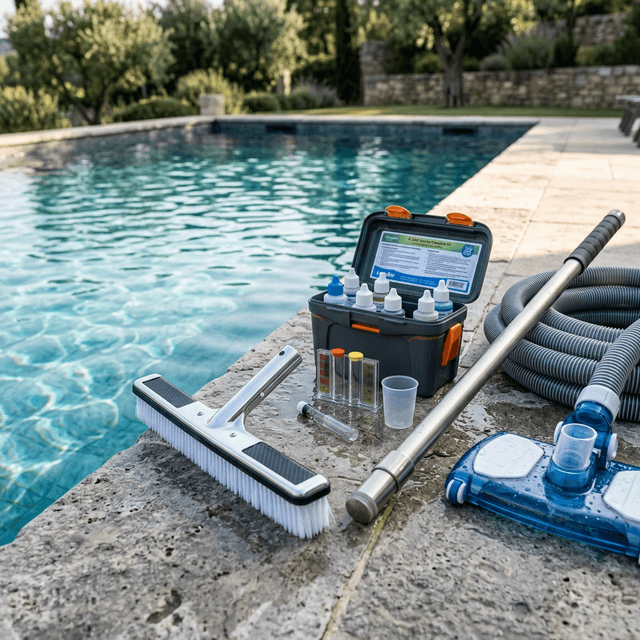
What you'll need
Before starting, gather these supplies. We stock everything listed at our Northlake pool supply store and on our online shop:
- Liquid chlorine (sodium hypochlorite, 10-12.5%) — this is the preferred shock for green pool recovery because it adds zero CYA and works immediately. Cal-hypo granular is an alternative but adds calcium (a concern with DFW hard water)
- Muriatic acid — for pH adjustment
- FAS-DPD test kit — liquid test kit that measures high chlorine levels accurately (standard test strips max out at 10 ppm, which is useless for SLAM)
- CYA test kit — to determine your target shock level
- Pool brush — stiff bristle for plaster, nylon for vinyl/fiberglass
- Leaf net / skimmer — for removing large debris
- Bucket — for pre-dissolving granular shock if using cal-hypo
Step 1: Remove large debris
Before adding any chemicals, remove as much physical debris as possible:
- Net out leaves, sticks, insects, and any floating material
- If the pool has heavy debris on the bottom, use a leaf rake or vacuum to waste (bypass the filter)
- Clean out skimmer baskets and pump basket
- Do NOT try to vacuum the algae through your filter at this stage — it will clog immediately
Step 2: Test your water
Test and record these levels:
- Free chlorine (likely at or near zero)
- pH (target 7.2 before shocking)
- CYA (determines your shock target — see table above)
- Total alkalinity (informational at this stage)
- Calcium hardness (determines whether to use cal-hypo or liquid chlorine)
If you don't have a good test kit, bring a water sample to our Northlake store for free professional testing. We'll tell you exactly what you need. You can also read our Pool Water Testing Guide for testing fundamentals.
Step 3: Lower pH to 7.2
High pH dramatically reduces chlorine effectiveness. Before adding shock, bring pH down to 7.2 (the lower end of the safe range).
- Add muriatic acid according to your pool volume and current pH
- Wait 30-60 minutes with the pump running, then retest
- Target: 7.2 — at this pH, chlorine is at peak effectiveness
This step is especially important in DFW where tap water pH is often 7.8-8.2 and total alkalinity is 120-180 ppm.
Step 4: Add shock to reach target FC level
Based on your CYA level (from Step 2), calculate the amount of liquid chlorine needed to reach your target shock FC level.
Liquid chlorine dosing guide (12.5% sodium hypochlorite):
| Pool Size | Amount to Raise FC by 10 ppm |
|---|---|
| 10,000 gallons | 1 gallon |
| 15,000 gallons | 1.5 gallons |
| 20,000 gallons | 2 gallons |
| 25,000 gallons | 2.5 gallons |
| 30,000 gallons | 3 gallons |
Example: 20,000-gallon pool with CYA at 40 ppm. Target shock FC is 16 ppm. Current FC is 0. You need to add approximately 3.2 gallons of 12.5% liquid chlorine.
Cal-hypo dosing guide (68% calcium hypochlorite):
| Pool Size | Amount to Raise FC by 10 ppm |
|---|---|
| 10,000 gallons | 1.5 lbs |
| 15,000 gallons | 2.25 lbs |
| 20,000 gallons | 3 lbs |
| 25,000 gallons | 3.75 lbs |
| 30,000 gallons | 4.5 lbs |
DFW tip: If your calcium hardness is already above 300 ppm, stick with liquid chlorine to avoid adding more calcium to your already-hard water.
Pour liquid chlorine directly into the pool near a return jet with the pump running. If using cal-hypo, pre-dissolve in a bucket of pool water first, then pour around the perimeter.
Step 5: Brush everything
After adding shock, brush every surface in the pool:
- Walls, floor, steps, benches, and ledges
- Behind ladders and rails
- Inside corners and coves
- Around fittings, drains, and skimmer openings
Brushing breaks up algae colonies, exposes protected algae to the chlorine, and distributes chemicals. This is not optional — skipping brushing is one of the top reasons green pool treatment fails.
Step 6: Run the pump 24/7
From this point forward, your pump runs continuously until the pool is clear. No exceptions. Circulation distributes the chlorine, keeps it in contact with algae, and pushes dead algae into the filter.
If you have a variable speed pump, run it at high speed for the first 4-6 hours to maximize circulation, then drop to medium-high speed for continuous operation.
Step 7: Maintain shock level (this is the key)
Here's where the SLAM method differs from simply shocking and hoping. You must maintain your target FC level continuously. Algae-laden water consumes chlorine rapidly — a green pool can eat 5-10+ ppm of free chlorine per day.
Schedule:
- Test free chlorine every 4-6 hours during daylight
- Add more chlorine every time FC drops more than 2 ppm below your target
- Test once in the evening and dose to hold through the night
- Continue this cycle every day until all three completion criteria are met
Expect this:
- Day 1-2: Chlorine consumption is enormous. You may need to add shock 2-3 times per day
- Day 3-4: Chlorine consumption slows as algae dies. Pool starts turning from green to cloudy blue/grey
- Day 5-7: Chlorine holds longer. Water is clearing. Dead algae is being filtered out
Step 8: Manage your filter
Your filter is doing heavy lifting during recovery, catching millions of dead algae cells.
Cartridge filter:
- Clean the cartridge daily during green pool recovery
- Hose it off thoroughly each time
- If you have a spare cartridge, rotate them so one is always in the filter
- Deep clean with filter cleaner solution after recovery is complete
Sand filter:
- Backwash when pressure rises 8-10 PSI above clean baseline
- This may be 1-2 times per day during heavy algae treatment
- Consider adding a clarifier or filter aid to help the sand catch fine algae particles
DE filter:
- Backwash when pressure rises 8-10 PSI
- Add fresh DE after each backwash
- May need backwashing daily during treatment
Vacuum to waste when possible: If your system allows it, vacuuming dead algae directly to waste (bypassing the filter) speeds recovery dramatically and prevents filter overload. You'll lose water, so refill as needed.
Step 9: The overnight chlorine loss test (OCLT)
Once the water looks clear (you can see the main drain), perform this test:
- Test free chlorine after sunset (no UV effect)
- Record the FC number
- Do NOT add chemicals overnight
- Test FC again the next morning before sunrise
- If you lost 1 ppm or less, and combined chlorine is 0.5 ppm or less, and the water is clear — you passed. The SLAM is complete
- If you lost more than 1 ppm, algae is still alive. Continue the SLAM process
Step 10: Return to normal maintenance
Once you pass the OCLT:
- Allow free chlorine to naturally drop back to 2-4 ppm (stop adding shock)
- Balance all chemistry — pH, alkalinity, calcium, CYA
- Resume normal pump schedule
- Clean or replace the filter (it took a beating during recovery)
- Add a maintenance dose of algaecide as insurance
- Begin a regular shocking schedule to prevent recurrence — see our How to Shock Your Pool Guide
Timeline Expectations by Severity
| Severity | Days to Clear (DIY) | Chlorine Used (20K gal pool) | Filter Cleanings |
|---|---|---|---|
| Level 1 (light green) | 1-3 days | 3-5 gallons liquid chlorine | 1-2 |
| Level 2 (moderate green) | 3-5 days | 6-10 gallons | 3-5 |
| Level 3 (dark green) | 5-10 days | 10-20 gallons | 5-10 |
| Level 4 (swamp) | 7-14+ days | 15-30+ gallons | 10+ |
DFW summer note: In July-August, with water temps above 90 degrees F and intense UV, chlorine consumption during SLAM is 20-30% higher than these estimates. Budget accordingly.
Prevention: Keeping Your Pool From Going Green Again
Fixing a green pool once is enough. Here's how to prevent it from happening again.
Weekly prevention checklist
- Test chlorine twice per week — never let it drop below 1 ppm
- Shock weekly during summer — a standard maintenance shock every Sunday evening keeps chlorine demand under control
- Brush weekly — prevents biofilm that gives algae a foothold
- Run the pump 10-12 hours daily in summer — good circulation eliminates dead spots
- Clean the filter regularly — a dirty filter can't remove algae spores
- Keep pH at 7.2-7.6 — chlorine works best in this range
- Monitor CYA monthly — if it's climbing above 60 ppm, take action before it compromises your chlorine
- Use algaecide weekly — a polyquat algaecide (polyquat 60) provides a secondary layer of protection
DFW-specific prevention
- Watch CYA levels religiously — switch to liquid chlorine or unstabilized cal-hypo for shocking to slow CYA buildup. Consider liquid chlorine as your primary sanitizer if CYA is chronically high
- Don't skip maintenance before vacations — have someone maintain the pool or hire a professional service. A week without chlorine in Texas summer guarantees a green pool
- After storms, take action immediately — test and shock within 24 hours of any significant rain event
- Inspect equipment monthly — a failed pump, empty feeder, or malfunctioning salt cell can lead to zero chlorine within days
- Use a robotic pool cleaner — daily automatic cleaning removes organic debris that feeds algae
For a deeper understanding of algae types and targeted treatments, read our Pool Algae Types: Identification, Treatment & Prevention guide.
Common Mistakes That Keep Pools Green
Mistake 1: Under-dosing the shock
The most common failure. Adding one bag of shock to a severely green pool is like putting a band-aid on a broken leg. Algae consumes chlorine rapidly. You need to overwhelm it with a sustained high dose, not a one-time pulse.
Mistake 2: Shocking once and walking away
A single shock treatment raises chlorine temporarily, but algae-laden water can consume it all within hours. If you don't maintain shock level, the surviving algae regrows from whatever is left. The SLAM method works because it maintains killing concentration continuously.
Mistake 3: Not accounting for CYA
If your CYA is 80 ppm and you shock to 10 ppm FC, the effective chlorine available to kill algae is minimal. You need to shock based on your actual CYA level. See the CYA-adjusted target table above.
Mistake 4: Relying on algaecide to do the heavy lifting
Algaecide is a preventative, not a cure for an active bloom. Algaecide helps keep algae from establishing, but once the pool is green, chlorine is the only reliable killer. Add algaecide after the SLAM is complete, not as the primary treatment.
Mistake 5: Not running the pump
Some homeowners shock the pool and then turn off the pump "to let it work." This is backwards. The pump must run continuously during treatment for circulation, filtration, and chemical distribution. Stagnant water allows algae to settle and avoid contact with chlorine.
Mistake 6: Not cleaning the filter during treatment
A clogged filter can't remove dead algae from the water. If you don't clean or backwash during treatment, the water stays cloudy even though the algae is dead. Clean the filter daily during active recovery.
Mistake 7: Adding clarifier too early
Pool clarifier helps remove fine particles, but adding it to a still-green pool wastes it. Clarifier works after the algae is dead and the water is transitioning from cloudy to clear. Wait until you can see at least 3-4 feet deep before adding clarifier.
When to Call a Professional
DIY green pool recovery works well for Level 1 and Level 2 situations. For Level 3 and Level 4 pools, or when DIY efforts aren't producing results, professional service saves time, money, and frustration.
Call a professional when:
- The pool has been green for more than two weeks and DIY treatment hasn't cleared it
- You've used multiple rounds of shock with no improvement — there's likely a CYA issue, filtration problem, or ongoing contamination source
- The pool is Level 4 (swamp condition) — commercial-grade equipment clears these faster
- You don't have the time to test and dose every 4-6 hours for a week straight
- Equipment isn't working — a green pool with a broken pump or failed filter needs repair first
- You're not sure what you're dealing with — bring a water sample to our Northlake store for free testing and recommendations
- It's the start of swim season and you need results fast — professional recovery gets your pool swim-ready in 3-5 days with guaranteed results
What professional green-to-clean service includes:
- Complete water chemistry analysis
- Equipment inspection and repair if needed
- Commercial-grade shocking and continuous treatment
- Daily monitoring and chemical adjustment
- Filter cleaning and management throughout recovery
- Final water balance and swim-ready verification
We handle green pool recovery for homeowners across Northlake, Argyle, Flower Mound, Trophy Club, Justin, Roanoke, Bartonville, Denton, Highland Village, Lewisville, Southlake, and all DFW North communities.
Ready to get your pool back? Contact us for a free estimate or call (469) 455-1054. We also offer weekly maintenance plans that prevent green pools from ever happening, starting at $165/month.
Simplified Pools fixes green pools fast throughout DFW North. We serve Northlake, Argyle, Flower Mound, Trophy Club, Justin, Roanoke, Krum, Ponder, Bartonville, Westlake, Denton, Highland Village, Lewisville, Southlake, Corinth, Lantana, Cross Roads, Haslet, and surrounding communities. Contact us for professional green pool recovery or prevention.