Best Pool Test Kits for 2026: Strips, Liquid Kits & Digital Testers Compared
Testing your pool water is the single most important thing you can do to prevent problems. You cannot fix what you cannot measure, and guessing at chemical levels is how pools turn green, equipment corrodes, and swimmers get irritated skin and eyes. The good news: testing technology has never been better, with options ranging from simple dip strips to Bluetooth-connected smart monitors.
But which test method is actually worth your money? Which one gives you accurate, reliable readings that you can act on with confidence?
Here is an honest comparison of every pool testing option available in 2026 — test strips, liquid reagent kits, digital testers, and smart monitors — with specific recommendations for DFW pool owners who deal with our unique water chemistry challenges.
Why Testing Matters (More Than You Think)
Most pool problems are chemistry problems. Algae does not grow in properly chlorinated water. Equipment does not corrode at the right pH. Plaster does not stain when calcium and metals are balanced. Cloudy water clears when filtration and chemistry are both correct.
But you cannot maintain proper chemistry without accurate, regular testing. Here is what happens when pool owners skip testing or use inaccurate methods:
- Under-chlorination leads to algae blooms that cost $100-$500+ to treat
- Over-chlorination bleaches swimsuits, irritates skin, and damages vinyl or fiberglass surfaces
- High pH makes chlorine up to 80% less effective — you are paying for chemicals that are not working
- Low pH corrodes heat exchangers ($500-$2,000 to replace), salt cells ($400-$800), and metal fittings
- High CYA locks up chlorine effectiveness — an invisible problem that is extremely common in DFW pools using trichlor tablets
Testing is cheap insurance. A $20 test kit can prevent hundreds of dollars in chemical waste, equipment damage, and emergency pool treatments.
For a full explanation of what each test measures and what the ideal ranges are, see our Pool Water Testing Guide for Beginners.
What You Need to Test
Before choosing a test kit, understand the six essential pool water measurements:
| Test | Ideal Range | Why It Matters |
|---|---|---|
| Free Chlorine (FC) | 2-4 ppm | Primary sanitizer — kills bacteria and algae |
| pH | 7.2-7.6 | Affects chlorine effectiveness, swimmer comfort, equipment longevity |
| Total Alkalinity (TA) | 80-120 ppm | Buffers pH — prevents wild swings |
| Cyanuric Acid (CYA) | 30-50 ppm | Protects chlorine from UV — critical in Texas sun |
| Calcium Hardness (CH) | 200-400 ppm | Prevents plaster etching and scale formation |
| Total Chlorine (TC) | Should equal FC | The gap between TC and FC reveals combined chlorine (chloramines) |
DFW-specific note: North Texas tap water is naturally high in alkalinity (often 140-200 ppm) and calcium hardness (200-400 ppm from the source). CYA buildup from trichlor tablets is the number one hidden chemistry problem in our area. Any test kit you buy must be able to test CYA accurately — this eliminates many basic kits from consideration.
Option 1: Test Strips
Test strips are the fastest, easiest way to check pool water. You dip a strip in the water, wait 15-30 seconds, and compare the color pads to a chart on the bottle.
How They Work
Each strip has multiple reagent-coated pads that change color when exposed to pool water. You match the resulting colors against a reference chart to determine your chemical levels.
Advantages
- Speed: Results in 15-30 seconds
- Simplicity: No measuring, mixing, counting drops, or color comparisons between vials
- Portability: Pocket-sized, no accessories needed
- Low barrier: Anyone can use them with zero training
- Inexpensive per test: Typically $0.30-$0.75 per strip depending on brand and quantity
Disadvantages
- Accuracy limitations: Color-matching is subjective. Two people reading the same strip may interpret colors differently, especially in poor lighting.
- Cannot distinguish fine differences: If your FC is 2.5 ppm vs. 3.5 ppm, a strip probably will not tell you. This matters when dosing chemicals.
- CYA readings are unreliable on strips. Most strip-based CYA tests are imprecise in the 30-80 ppm range — exactly where DFW pool owners need accuracy most.
- Expire faster than liquid reagents once the bottle is opened. Moisture and heat degrade the pads.
- Temperature-sensitive storage. Leaving strips in a hot Texas garage or shed accelerates degradation.
Best Test Strips for 2026
7-way test strips from major pool brands are the most common. They test FC, TC, pH, TA, CH, CYA, and sometimes bromine. Look for strips that include all six essential tests in one dip.
What to look for when buying:
- Sealed, moisture-proof container with desiccant
- Recent manufacture date (check the bottle)
- At least 50 strips per container for value
- Clear, easy-to-read color chart with distinct color gradations
Best for: Quick daily chlorine and pH checks between more comprehensive testing. Not recommended as your sole testing method.
We carry multiple test strip brands at our Northlake store and online shop. Ask us which brand performs best in current stock.
Option 2: Liquid Reagent Test Kits
Liquid reagent kits are the professional standard. Pool service companies, water treatment facilities, and serious DIY pool owners use liquid reagent kits because they deliver the most accurate and repeatable results available without laboratory equipment.
How They Work
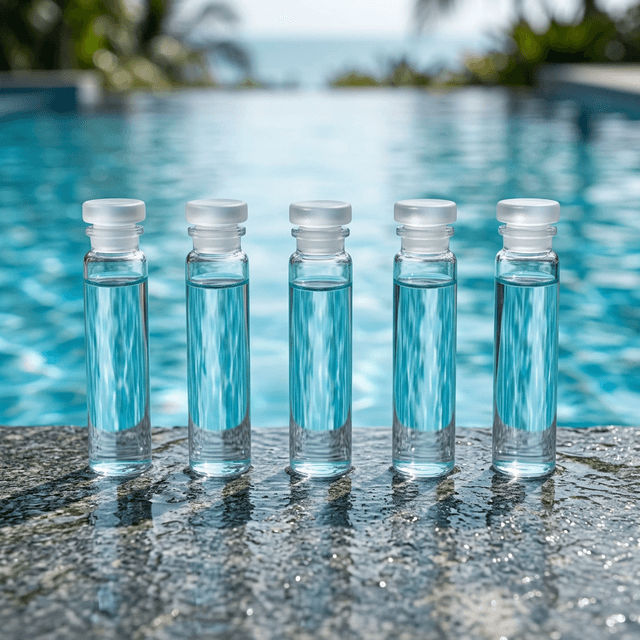
You collect a water sample in a test vial, add a specific number of drops of a chemical reagent, and observe the color change. Some tests use color comparison (match the sample color to a reference), while others use drop-count titration (count how many drops it takes to change the sample color — each drop represents a measured amount of chemical).
Advantages
- Accuracy: Drop-count titration is significantly more accurate than color-matching strips. You get precise numbers, not approximate ranges.
- CYA testing is reliable. The turbidity (cloudiness) test for CYA in liquid kits is far more accurate than strip-based CYA tests. This matters enormously in DFW.
- Distinguishes fine differences. You can measure FC at 2.0, 2.5, 3.0, 3.5, or 4.0 ppm — precision that strips cannot match.
- Long reagent shelf life. Properly stored reagents last 1-2 years (some longer). This is better than strip shelf life after opening.
- Professional credibility. When you call a pool service company and describe your readings from a Taylor K-2006, they know exactly what your water needs.
Disadvantages
- Learning curve. Counting drops, reading comparators, and following test procedures takes practice. First-time users may feel overwhelmed.
- Slower testing. A full suite of tests takes 10-15 minutes compared to 30 seconds for a strip.
- Reagent replacement cost. Individual reagent bottles need to be replaced as they run out. Heavy testers may spend $30-$60/year on replacement reagents.
- Color reading in poor light. Some color comparisons (especially pH) are difficult to read in low light or with color blindness.
- More components to manage. Test vials, comparator blocks, and multiple reagent bottles require organization.
Best Liquid Reagent Kits for 2026
Taylor K-2006 Complete Test Kit
This is the industry standard for residential pool testing. Pool service professionals across the country — including our team at Simplified Pools — rely on Taylor reagent chemistry.
What it tests: FC, TC, combined chlorine, pH, TA, CH, CYA
Why it is the best:
- FAS-DPD chlorine testing (drop count) is the most accurate residential chlorine test available
- CYA turbidity test gives reliable readings — essential for DFW
- Every major pool chemistry forum, professional organization, and water chemistry resource recommends this kit
- Replacement reagent refills are available for individual chemicals so you do not rebuy the entire kit
Taylor K-1003 Basic Kit
A more affordable option that covers FC, pH, and acid demand. Good for frequent quick checks if you also own a full kit for comprehensive monthly testing.
Other reputable brands include LaMotte and Poolmaster professional-grade kits. All use similar reagent chemistry. Taylor is the most widely available and best-supported.
We stock Taylor test kits and replacement reagents at our Northlake store and online shop.
Option 3: Digital/Electronic Testers
Digital testers use electronic sensors instead of chemical reagents to measure water parameters. They display numerical readings on a screen — no color matching or drop counting required.
How They Work
Depending on the tester, a probe or sensor is dipped into a water sample or directly into the pool. The sensor measures electrical properties of the water (conductivity, oxidation-reduction potential, ion concentration) and converts those to chemical readings displayed digitally.
Types of Digital Testers
Handheld digital meters — compact devices that test one or two parameters each (usually pH/chlorine or pH/ORP). Dip the probe into a water sample and read the screen.
Photometers — portable devices that use light transmission through a water sample with a reagent tablet added. The device measures light absorption and calculates the concentration digitally. More accurate than color-matching but still uses reagent tablets.
Multi-parameter testers — higher-end devices that test multiple parameters (pH, ORP, TDS, temperature, conductivity) in a single unit.
Advantages
- Objective readings. No subjective color matching — the number is the number
- Fast. Most give readings in 10-30 seconds per parameter
- Easy to read. Digital display eliminates interpretation guesswork
- Repeatable. Consistent readings when properly calibrated
- Some models log data and track trends over time
Disadvantages
- Calibration required. Digital testers must be calibrated regularly with standard solutions. Without calibration, readings drift and become inaccurate. Many homeowners skip calibration, producing worse results than a simple test strip.
- Do not test everything. Most handheld digital testers measure pH, ORP (which correlates to but does not directly measure chlorine), temperature, and TDS. They typically cannot test TA, CH, or CYA — the three parameters DFW pool owners most need to monitor.
- Probe maintenance. Sensor probes require cleaning, proper storage (usually in storage solution), and periodic replacement. Neglected probes give bad readings.
- Higher upfront cost. $50-$300+ depending on capability, compared to $10-$15 for strips or $60-$100 for a complete liquid kit.
- ORP is not the same as chlorine. Many digital testers measure ORP (oxidation-reduction potential) rather than free chlorine directly. ORP is influenced by pH, temperature, CYA, and other factors. A "good" ORP reading does not necessarily mean your chlorine level is where you need it.
Best Digital Testers for 2026
Digital photometers are the most useful digital option for pool owners because they still use reagents for accuracy but eliminate subjective color matching. Look for models that test FC (not just ORP), pH, TA, and CH at minimum.
Handheld pH/ORP meters are good supplemental tools if you want a quick pH check between comprehensive tests. They are not a complete testing solution on their own.
Our recommendation: A digital tester works best as a companion to a liquid reagent kit, not as a replacement. Use the digital meter for quick daily pH and chlorine checks, and the liquid kit for comprehensive weekly testing.
Digital testers and photometer reagent refills are available at our Northlake store.
Option 4: Smart Pool Monitors
Smart pool monitors are the newest category of pool testing technology. These devices sit in your pool or plumbing and continuously monitor water chemistry, sending data to your phone.
How They Work
A floating or inline sensor unit contains probes that measure water parameters (typically temperature, pH, ORP, and sometimes TDS or conductivity) on a continuous basis. Data syncs to a smartphone app via Bluetooth or Wi-Fi. The app displays current readings, trends, and dosing recommendations.
Advantages
- Continuous monitoring. You see real-time data on your phone without walking to the pool
- Trend tracking. See how chemistry changes over the day, week, or season — spot patterns you would miss with periodic testing
- Alerts. Get notified when a parameter goes out of range
- Convenience. No manual testing required for the parameters the device covers
- Historical data. Review past readings to understand your pool's behavior
Disadvantages
- Highest cost. $200-$600+ for the monitor, plus annual subscriptions for some apps and sensor replacement costs
- Limited parameters. Most smart monitors only measure pH, ORP, and temperature. They cannot measure FC directly, TA, CH, or CYA. You still need a manual test kit for comprehensive testing.
- ORP limitations. Same issue as digital testers — ORP is not a direct chlorine measurement and is affected by CYA levels, which are a major concern in DFW.
- Sensor lifespan. Probes degrade over time (typically 1-2 seasons) and require replacement
- Connectivity issues. Bluetooth range is limited. Wi-Fi models require a strong signal at the pool.
- Battery life. Floating units need periodic charging or battery replacement
Our Recommendation
Smart monitors are a useful supplement for pool owners who want visibility into daily trends, but they do not replace manual testing. You still need a liquid reagent kit for accurate FC, TA, CH, and CYA readings — the parameters that matter most for DFW water chemistry.
If you are interested in a smart monitor, we can help you choose the right one at our Northlake store.
Accuracy Comparison: How Do They Stack Up?
| Parameter | Test Strips | Liquid Reagent | Digital Meter | Smart Monitor |
|---|---|---|---|---|
| Free Chlorine | Fair (approximate) | Excellent (FAS-DPD) | Good (photometer) / Poor (ORP) | Poor (ORP only) |
| pH | Fair | Good-Excellent | Excellent (when calibrated) | Good (when calibrated) |
| Total Alkalinity | Fair | Excellent | Not tested | Not tested |
| Calcium Hardness | Fair | Excellent | Not tested | Not tested |
| CYA | Poor | Good (turbidity test) | Not tested | Not tested |
| Combined Chlorine | Not tested | Excellent | Not tested | Not tested |
The verdict for DFW pool owners: A liquid reagent kit (Taylor K-2006 or equivalent) is the only testing method that accurately covers all six essential parameters, including CYA — the hidden problem in North Texas pools.
Cost Comparison
| Method | Upfront Cost | Annual Ongoing Cost | Cost Per Full Test |
|---|---|---|---|
| Test strips (7-way) | $10-$20 | $50-$100 (replacing strips) | $0.30-$0.75 |
| Taylor K-2006 | $80-$100 | $30-$60 (reagent refills) | $1.50-$2.50 |
| Digital photometer | $100-$250 | $30-$50 (reagent tablets) | $1.00-$2.00 |
| Handheld pH/ORP meter | $50-$150 | $20-$40 (calibration solution, probes) | $0.50 (pH only) |
| Smart monitor | $200-$600 | $50-$150 (sensors, subscriptions) | N/A (continuous) |
Best value: The Taylor K-2006 offers the best balance of accuracy, comprehensive testing, and cost. It pays for itself the first time it prevents an algae bloom or catches a chemistry problem early.
Our Recommended Testing Strategy for DFW Pool Owners
Based on our experience servicing hundreds of pools across Northlake, Argyle, Flower Mound, Trophy Club, and the surrounding DFW North area, here is what actually works:
The Two-Kit Approach
-
Test strips for quick daily checks (2-3 times per week in summer, weekly in winter). Use them for a fast chlorine and pH snapshot. If anything looks off, follow up with your liquid kit.
-
Taylor K-2006 for comprehensive weekly testing. Every week, do a full FC, pH, TA, and CYA test. Monthly, add CH. This catches problems before they become expensive.
Testing Schedule
| Test | Frequency | Method |
|---|---|---|
| Free Chlorine | 2-3x/week (summer), weekly (winter) | Strip or liquid |
| pH | 2-3x/week (summer), weekly (winter) | Strip or liquid |
| Total Alkalinity | Weekly | Liquid kit |
| CYA | Monthly (or after adding stabilized chlorine) | Liquid kit only |
| Calcium Hardness | Monthly | Liquid kit |
| Combined Chlorine | Weekly (or when water smells "chloriney") | Liquid kit |
DFW-Specific Testing Tips
- Test CYA every month if you use trichlor tablets. CYA creep is the most common chemistry problem we see in DFW pools. See our guide on Why You Should Always Test Before Adding Chemicals for more detail.
- Test after every major rain. DFW thunderstorms can dilute chemistry, add contaminants, and shift pH significantly.
- Test calcium hardness quarterly at minimum. DFW tap water is hard, and topping off the pool gradually increases CH.
- Always test before adding chemicals. Never dose based on a schedule or a guess. See our guide: Why You Should Always Test Before Adding Chemicals.
Free Water Testing at Our Store
Not sure you are reading your test results correctly? Bring a water sample to our Northlake store and we will test it for free using professional-grade equipment. We test FC, pH, TA, CH, CYA, salt (if applicable), and metals — then we tell you exactly what to add, how much, and in what order.
This is the best way to calibrate your home test kit. Compare your home readings to our professional results and see if your kit is giving you accurate numbers.
Free water testing is available during all store hours. No appointment needed. Just bring at least 8 ounces of pool water collected from elbow depth, away from return jets.
Or Let Us Test Every Week
Our weekly service plans include comprehensive water testing at every single visit:
- Chemical-Only ($165/mo): Professional testing + chemical balancing every week
- Basic ($210/mo): Testing + chemicals + brushing + skimming + equipment checks
- Premium ($250/mo): Everything above + vacuuming + filter cleaning + priority service
Every visit includes a digital report sent directly to your phone showing exactly what we tested, what we found, and what we adjusted. You always know the state of your water without lifting a finger.
Get your free quote or call (469) 455-1054.
Simplified Pools carries test strips, Taylor K-2006 kits, replacement reagents, digital testers, and smart pool monitors at our Northlake store and online shop. Free professional water testing at our store — bring a sample anytime. Serving Northlake, Argyle, Flower Mound, Trophy Club, Denton, Highland Village, Lewisville, Southlake, Corinth, Lantana, Cross Roads, and Haslet.